Artificial Sociality
August 6, 2025
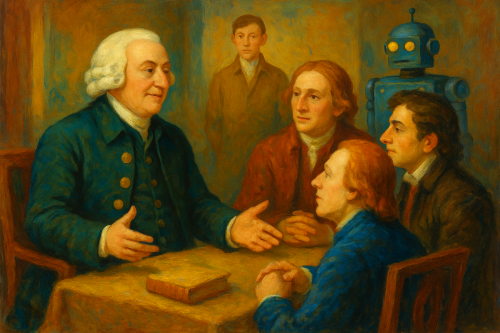
...what we would be asking about robots is, do (can) robots ever imagine another’s circumstances so as to enter into those circumstances and any of the existent sentiments associated therein?
...what we would be asking about robots is, do (can) robots ever imagine another’s circumstances so as to enter into those circumstances and any of the existent sentiments associated therein?
Can human beings and machines with artificial intelligence (AI) be friends or social companions? It is easy enough to imagine a machine which looks just like a regular human and, with the sophistication of AI, acts like one as well. It would seem that not only could we socialize with robots as we do with other humans, but we also might face situations where we would be asking, “is that a human or a robot?” But before we rush headlong into the equality of human-to-robot relations, perhaps we might ask ourselves what goes on in a socialization process? Is it really as simple as having the same sorts of attitudes and sentiments as another? We can imagine an AI robot imitating emotions and attitudes quite well. They would display them at the appropriate time and in the appropriate way. But does that solve the problem?
When it comes to sentiments and socialization there is seldom a better place to look than to Adam Smith and his Theory of Moral Sentiments. The moral sentiments were built out of, and exercised in, a social context. They presuppose some sort of sociality as well as advance it. That morality, and its accompanying sentiments, emerge in a social context seems obvious; it is not uncommon to rush from this realization to the main components of Smith’s theory, such as the impartial spectator, self-command, self-interest, the virtues, and the like. Yet in the rush to start working the theory, there is an important dimension of that theory found in the very opening pages of the book that often gets forgotten or ignored. This process is what Smith calls “the correspondence of sentiment.” And before getting to what this process involves, we can notice that Smith says “correspondence” and not “identity.”
But what exactly is this “correspondence of sentiment?” After noting that “we may judge of the propriety or impropriety of the sentiments of another person by their correspondence or disagreement with our own,” (TMS I.i.4.1) Smith puts the main part of correspondence as follows:
In all such cases, that there may be some correspondence of sentiments between the spectator and the person principally concerned, the spectator must, first of all, endeavor, as much as he can, to put himself in the situation of the other, and to bring home to himself every little circumstance of distress which can possibly occur to the sufferer. He must adopt the whole case of his companion with all its minutest incidents; and strive to render, as perfect as possible, that imaginary change of situation upon which his sympathy is founded. After all this, however, the emotions of the spectator will still be very apt to fall short of the violence of what is felt by the sufferer. (TMS I.i.4.6-7)
The ”spectator” is simply a person observing an action (or set of actions). It could be someone observing you or observing someone else, or yourself observing others. When in the company of others, we both spectate and are the objects of spectators. And although this passage is referring to a situation of some distress, positive situations work the same way. Thus, although the wording in this case sounds negative, in a happier case my happiness about your becoming engaged, let’s say, will “fall short of the violence of what is felt by” you. There is a correspondence but not an identity: “though they will never be unisons they may be concords, and this is all that is wanted or required.” (TMS I.i.4.7)
It is equally important to notice that the whole burden of the correspondence does not lie solely with the spectator. The object of the spectating in these situations also has some work to do. In situations where sentiments can be extreme, Smith says the following:
In order to produce this concord, as nature teaches the spectators to assume the circumstances of the person principally concerned, so she teaches this last in some measure to assume those of the spectators. (TMS I.i.4.8)
That is, the person who is the object of spectating must exert some effort of his or her own to get correspondence with the spectator. The foregoing comment
was made about strong sentiments, but the process really applies to all sentiments. (TMS I.i.5.3)
At some point in the process, we learn to moderate our sentiments so that the “impartial spectator” can enter into them. (TMS I.i.5.8) This latter case suggests a moderation designed to meet some standard of worthiness—that is, we moderate to make our sentiments appropriate to the situation and evaluate ourselves and others accordingly. Consequently, correspondence has two broad dimensions. The first is the process of finding a sentiment on the part of spectator and the person upon whom one is spectating that corresponds to a point where there is concord between them. The sentiments seem to be more or less the same. This correspondence is accomplished by moderating or enhancing the relevant sentiments among the persons trying to relate to each other through imagination. I need to enhance, say, my experience of grief so that I can enter into the grief you are experiencing after losing a loved one. You, on the other hand, need to moderate your grief to a level that allows it to correspond with what I am likely able to imagine. Mine can never match the actual depth or nature of yours.
All this is built upon the natural fact that we like to be around those whose sentiments are like our own. The second broad dimension of correspondence is the one where we not only want shared sentiments, but also sentiments that meet some standard of impartial appropriateness. The first broad type establishes sociality. The second broad type, signified by the deployment of the impartial spectator, adds an aspirational component that serves to guide the socialization process across a variety of individuals and their circumstances. The first broad category is experiential; the second normative. Both are the grounds of socialization.
If this is an accurate description of the components needed for socialization, then a few things follow. First is the point made above about it being sufficient for concord if the sentiments of the two parties can never really be exactly alike. They cannot be the same because our sentiments “never did, and never can, carry us beyond our own person.” Instead, “it is by the imagination only that we can form any conception of what are [another’s] sensations.” (TMS i.i.1,2) Without an act of imagination by both parties, there is no correspondence or concord.
Secondly, the situation matters, especially when the impartial spectator is present. Smith tells us that “sympathy…does not arise so much from the view of the passion, as from that of the situation that excites it.” (TMS I.i.1.10) When the impartial spectator is present, we look to see if the sentiment, both in its nature and degree of expression, are appropriate to the situation. Yet even without the impartial spectator, the situation is the basic cause of the sentiment. Our sentiments are aroused by events to which we are prone to react. Participants can react the same or differently to an event and sorting out those differences is part of process of correspondence. It is possible that one may have no reaction to an event to which another has a strong reaction. In such cases, correspondence comes from an inquiry into why there is that reaction by the other. In any case, the characteristics of the situation are significant for arousing the sentiments relevant to a correspondence.
Third, built into a situation is an invitation to include the impartial spectator. Smith notes that, “originally…we approve of another man’s judgment, not as something useful, but as right, as accurate, as agreeable to truth and reality.” (TMS I.i.1.4) Of course, Smith notes that what is often regarded as “true” or “real” is simply what we ourselves regard as being true or real. Here we would look simply for agreement with our own opinion. Even so, we have here a different standard of agreement. We are corresponding on the appropriateness of the sentiments, not simply on their ability to express concord. Once appropriateness enters the picture, the door is open for the impartial spectator to enter as well. That entrance may complicate matters, but it does not fundamentally alter the desire for correspondence.
It is essentially what is common to all three of these dimensions that interests us the most here. That commonality is the recognition that correspondence is an activity or process, not a mere matching. If that is true, it says something important about socialization. This is not to say that the end of just getting concord does not matter; but it is an end point and not just a match. If I discover you feel the same as I do about something, I’m pleased; but I have invested nothing and learned nothing beyond that. To really correspond, some investment by each of us in the process of correspondence is necessary. That process involves making some sort of investment in the other. It seems that this is what Smith believes as well. The first line of TMS describes our natural interest in the ideas and sentiments of others. We may want another’s sentiments to agree with our own, but the whole discussion of correspondence shows that “agreement” is a mutual process. Both parties need to imagine the situation of the other and thereby any applicable standards of appropriateness. That investment in the other through our efforts of imagination concerning their circumstances or feelings is a process. This process is the essence of socialization. A mere match of sentiments is simply a repetition of self. Socialization involves investment in others as others. Simple matches are an investment in oneself.
If the foregoing is accurate, we can come back to the question of having an AI friend. Friendship, of course, is a very high level of socialization where there is serious and sustained investment in the other. I do not want to set the bar that high. For our purposes “friend” means anything from someone we have just gotten to know and like to those we have known and interacted with much longer—what might be called just normal socialization. Contrary to the opening impression at the state of this essay, I do not intend to offer an answer to whether we can be friends with robots. I do not know enough about AI or robots to feel comfortable making judgments in this area. I only want to refer to them as a way of proposing more dramatically a standard that must be met for there to be socialization. That standard is investment in the other and the other’s circumstances and feelings through an act of imaginary identification and approval. In other words, the process of correspondence of sentiment we have been considering all along here.
Hence, what we would be asking about robots is, do (can) robots ever imagine another’s circumstances so as to enter into those circumstances and any of the existent sentiments associated therein? That question gives rise to many others. For example, does the other seek to understand the robot well enough to moderate one’s sentiment so as to correspond with that of the robot’s—assuming it makes sense to talk about robot sentiments? Can robots moderate and correspond their own sentiments to others in this way? Does it matter to the process if one knows the other is a robot? Would the process of correspondence be the same between two robots as it would be in a human-robot relationship? I do not know the answer to these questions; but acts of correspondence are what humans and robots would have to do to accomplish Smithian socialization.
Yet perhaps socialization does not matter. Human-robot correspondence is just different from human-human correspondence. That’s fine if the difference is recognized. From my limited experience with what we have now,1 robots are programmed to offer us what we want to hear, experience, or what are generally the usual responses to situations. They do not make the investment of discovery about the individual’s particular context, personality, aspirations, and the like—which is not to say sentiments are not expressed when one interacts with a robot. Yet even if it could be argued that robots can elicit sentiments from us through some sort of an act of discovery (as opposed to us just making our sentiments evident to the robot), the usual purpose is to apply any such resulting sentiments to oneself—for example having the robot express “grief” at loss we ourselves have experienced so as to comfort one’s self. The response elicited from the robot would seem to be you externalizing yourself, and not a you that is the result of a robot discovery of how best to moderate its own sentiments to correspond with your own.
None of this is meant as a criticism of robot-human relations, or of robot technology, or of AI generally. Many people today profit from interactions with avatars or robots. They can be a source of companionship that can help us with our own emotional being. But this sort of companionship is also available with pets. In both cases, we ourselves are the purpose of the relationship, not the pet or robot. My intent here is not to criticize these relationships. It is rather to point out the difference between socializing and socialization. We can socialize by being put amid other people, or socialize when we are engaged with others in some other mode of joint contact (i.e. email, Facebook, etc.). Socialization, by contrast, refers to making an investment of sympathy with others in order to secure a joint sympathy beyond a simple matching of sentiment found at the level of an acquaintance.
Put in these terms, not only is socializing (being with or among others) not necessarily socialization (becoming the other), but the former can often be confused with the latter. Take email for example. There is definitely socializing going on. But is there socialization? Perhaps we are inclined to think so, but it is so difficult to convey the proper level of sentiment that we have invented a whole system of symbols called “emojis” to help us along. Even with emojis, it is very difficult to tell the level of sentiment being conveyed. Moreover, because of the distance and invisibility between interlocutors, one can present oneself in many false ways without discovery. Again, this is not to disparage email. Email is a marvelous way to socialize, for a variety of modes of communication are thus opened to us. But as a medium of socialization email has its hurdles.
Correspondence calls to mind another concept that Smith regards as central to human action, namely, exchange. It is a propensity we as humans naturally possess and is the foundation of commerce. (WN I.ii.1) And as Smith notes, exchange is not found in animals. Cooperation is either programmed into them, or they are self-sufficient. Animals do not exchange this for that or bargain to find a point of mutual satisfaction in exchange. Human beings do. Correspondence is the analogue of exchange when it comes to our sentiments. Things are not exchanged, but in a way experiences are. Both parties, through imagination, endeavor to alter their experience to a point where the other person can enter into it. One gives a response which in turn calls forth another response until both parties believe they have found a mutual point of shared experience. Exchange is, after all, a form of accommodation to the other, and accommodation to others is a central part of socialization.
I raise this point about exchange and correspondence not so much to put forth another analogy, or just to show that the propensity behind the process of exchange can manifest itself in different ways. The latter point confirms the universality of the propensity in human nature, which is important in itself. Yet a point similar to the one just made above can also be made here. In Smith’s Day, commerce no doubt had a predominance of personal exchanges. Today many, if not most, of our exchanges are impersonal. We walk into a store with a large supply of goods with prices attached. We do not bargain or see persons willing to make a deal with the products displayed. We interact only with the check-out person or someone in the return department—socializing without socialization. If one pauses to think about it, a great deal of one’s life is like this. We act to satisfy our own needs and wants, and what is offered to us is what we choose for ourselves. There is nothing wrong with this either; in fact these offerings enhance our lives on many levels. But these sorts of exchanges do not do the work of an actual correspondence.
Instead of wondering whether we can be friends with robots, perhaps we should wonder where we can find friends with other humans these days! The query about human friends is not a segway into a complaint that we live in a selfish culture. That complaint is often an example of what it is complaining about, namely, “how come nobody is making friends with me!” It’s not the amount of “stuff” that is available to satisfy us that is the issue; it is that action needs to be initiated towards, and invested in, others for there to be correspondence. Exchanges need to be personal. What is worrisome is not that there are impersonal exchanges, but that there may be an increase in depersonalizing exchanges, such as canceling others, especially in politics. Maybe just recognizing that Smithean correspondence teaches us that socializing is not necessarily socialization, and thus that correspondence is called for, will be the first step in bringing forth lasting cooperation. We can then move from there to appropriateness.
- I have spent a brief amount of time with Replika, for example.↩︎