A Little Lower Than the Angels: What the Founders Learned from Adam Smith (Part 2)
June 19, 2025
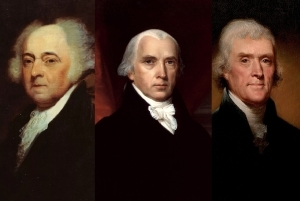
Fleishacker argues that Adams, Jefferson, and Madison applied Smith's conception of virtue backed up by self-interest.
Fleishacker argues that Adams, Jefferson, and Madison applied Smith's conception of virtue backed up by self-interest.
This essay appears in two parts. This is Part 2, you can find Part 1 here.
1. Smith and the Founders on Human Nature: An Overview
We see a view of people as having a limited amount of “civic virtue” that needs to be supplemented by structures making room for, and properly channeling, their private interests, in many defenders of the Constitution. Noah Webster writes that “virtue, … or love of country” cannot be “a fixed, permanent principle and support of government,” but he is nevertheless concerned with the “dignity” of the people and with guarding the republic against “corruption.” Pelatiah Webster believed Congressional representatives should have such virtues as wisdom and integrity but warned that we need to expect many of them to fail in this regard. James Madison writes that no form of government can secure liberty or happiness without virtue in the people, but nonetheless wants governments to be set up so that “opposite and rival interests” could supply “the defect of better motives.”[1]
There is virtue in human beings, according to these Smithian politicians, but it is fragile: wisdom lies in drawing on it when it is most likely to appear, and hedging it around with bonds based on self-interest.
As regards the relationship between government and religion, some of the founders who were otherwise influenced by Adam Smith held views that were closer to Smith’s teacher Francis Hutcheson. Benjamin Rush, for instance, believed that “Christianity is the only true and perfect religion” and that it should be taught, via the Bible, in schools.[2]
John Adams, on the other hand, dissented from the subcommittee he was on, to draw up a Massachusetts constitution, precisely on the issue of mandatory religious instruction. “The Article respecting Religion. . . was the only Article which I omitted to draw,” he said later on: “I found I could not sketch [any such Article] consistent with my own sentiments of perfect religious freedom, with any hope of its being adopted by the Convention.”[3] And Madison and Thomas Jefferson agreed wholeheartedly with Smith on the need to keep government out of religion — there is even some reason to think that Madison adopted Smith’s argument for the proliferation of religious sects only after reading Smith’s Inquiry into the Nature and Causes of the Wealth of Nations (WN).[4]
Madison and Jefferson also shared Smith’s preference, more generally, for good institutional design, rather than direct teaching, as a means of fostering virtue in the citizenry. That is partly because they, along with many of the other founders, agreed with Smith that people’s economic occupations shape their private virtues or vices. Even Rush agrees with Smith that market interactions can shape our character: he describes commerce as “next to religion in humanizing mankind.”
Smith’s recognition that some occupations are harmful rather than helpful to morals got taken up by many Americans. Smith’s words almost certainly lie behind Noah Webster’s 1785 note on the “mental mutilation” brought on by manufactures and Madison’s 1792 discussion of the intellectual virtues of husbandmen and vices of sailors, and they may well have indirectly inspired the many other participants in the debates over domestic manufacturing in the 1790s who worried about the ill-effects on character of manufacturing work, and praised the moral qualities of agricultural laborers.[5] What Drew McCoy calls the Jeffersonian concern with “the mode and tempo of acquiring wealth” may well have had its source in, and was certainly informed by, Smith’s arguments for the link between economic occupation and character.[6]
Finally, Smith’s high regard for the virtues of untutored, ordinary people — which flows, I argued above, from his view that virtue arises more from everyday interactions than from formal teaching — can also be found in such American admirers of his as Madison, Jefferson, and James Wilson.[7] This attitude is expressed in such places as Jefferson’s famous claim that a ploughman will decide moral issues better than a professor, and in Madison’s avowals of trust in the virtue and intelligence of the people.[8] It is also displayed in the view that Madison and Jefferson take towards state-established churches. Government support for a church was most commonly justified, in the eighteenth century, as a means for teaching virtue to the people, and Madison and Jefferson were among the few who argued, like Smith, that such teaching is unnecessary.
2. Smith and Adams
Let’s now look more closely at how three of the most important founders used Smith in their thinking. I begin with John Adams. In her terrific book, Adam Smith’s America, Glory Liu tells us that Adams’s wife Abigail, son John Quincy, and niece Lucy Cranch were reading The Theory of Moral Sentiments (TMS) by 1786, and that John Adams told John Quincy in 1790 that both of Smith’s books deserved his “Attention in a very high Degree.”[9]
In 1790, Adams also began writing a set of essays he called Discourses on Davila, which made extensive use of TMS. One long chapter (VIII) consists almost entirely of an excerpt from TMS, on the vanity of fame and power. Elsewhere, Adams paraphrases Smith. “What is the end of avarice?” Adams writes; “… A competence to satisfy the wants of nature, food and clothes, a shelter from the seasons, and the comforts of a family, may be had for very little. The daily toil of the million, and of millions of millions, is adequate to a complete supply of these necessities and conveniences.”[10] Smith had written, “What is the end of avarice and ambition … ? Is it to supply the necessities of nature? The wages of the meanest labourer can supply them. We see that they afford him food and clothing, the comfort of a house, and of a family.” (TMS I.iii.2.1; 50). Smith also says, “[W]ealth and greatness are often regarded with the respect and admiration which are due only to wisdom and virtue, and … the contempt, of which vice and folly are the only proper objects, is often most unjustly bestowed upon poverty and weakness (TMS I.iii.3.1, 61–62). Which Adams paraphrases as follows: “What disgrace can there be in poverty? … is not the sense of propriety and the sense of merit as much connected with a full purse as with an empty one?” (Adams, Discourse 238).
Here is Smith again:
“The poor man … is ashamed of his poverty. He feels that it … places him out of the sight of mankind … [T]hough to be overlooked, and to be disapproved of, are things entirely different, yet as obscurity covers us from the daylight of honour and approbation, to feel that we are taken no notice of, necessarily … disappoints the most ardent desire of human nature. The poor man goes out and comes in unheeded, and when in the midst of a crowd is in the same obscurity as if shut up in his own hovel.” (TMS I.iii.2.1, 51)
And Adams:
“[The poor man] is ashamed … He feels himself out of sight of others, groping in the dark. Mankind take no notice of him. … In the midst of a crowd, at church, in the market, at a play, … he is in as much obscurity as he would be in a garret or a cellar. He is not disapproved, censured or reproached; he is only not seen.” (Adams, Discourses 239; Adams’ emphasis)
It is striking that Adams is yet more direct than Smith in his condemnation of those who despise people for being poor (“What disgrace can there be in poverty?”). The mere fact that Adams spends so much time on Smith’s thoughts on the condition of the poor is also striking. One thing Adams takes from Smith is the idea that there is a delusion underlying our pursuit of wealth, and that that pursuit distracts us from a more proper attention to virtue, and to the virtues of the poor in particular. Adams’ point throughout the Discourses on Davila, and the reason why he brings Smith into it, is to stress that we ought only to admire and seek virtue but have strong natural tendencies to be misdirected towards seeking wealth and status instead — he wants us to be realistic about that, even while seeking to overcome these tendencies.
Liu argues that Adams was trying to warn his more optimistic contemporaries that they should not take for granted that democracy would automatically bring about an egalitarian ethos — he used Smith “to articulate a chronic worry that he believed his contemporaries were ignoring.”[11] Our disposition to admire the rich and famous, for Adams, can lead us to institute oligarchy rather than democracy, seeking out wealthy rather than virtuous leaders. So Adams clearly saw in Smith an ally for a powerful critique of wealth-seeking. Nothing could be further from the valorization of wealth seeking and self-interest with which Smith is commonly associated today.
But more important for our present purposes is that Adams seems fully to recognize, and to endorse, Smith’s social and non-discursive picture of how we develop moral character, and a sense of ourselves. He takes up Smith’s emphasis on the invisibility of poverty and elaborates it in yet more powerful language than Smith himself uses. “The poor man goes out and comes in unheeded,” says Smith, “and when in the midst of a crowd is in the same obscurity as if shut up in his own hovel.” For Adams, the poor man not only feels “out of sight of others” but is “groping in the dark.” Adams also adds “at church, in the market, at a play” to Smith’s “in the midst of a crowd,” turns the “hovel” in which the poor man lives for Smith into “a garret or a cellar,” and expands Smith’s overall point about the invisibility of the poor — a point that has been little stressed in writings about the poor until quite recent times — by saying that the poor man “is not disapproved, censured or reproached; he is only not seen”: using, in that remarkable final clause, emphasized by Adams himself, terms that have become current discourse only over the past decade or so in our own time.
Adams thus seems clearly to have picked up from Smith the enormous importance of social visibility — the way we view and are viewed by other people around us — to our self-respect and moral development. That goes along, as we have seen, with a recognition that social interaction, far more than formal teaching, shapes our characters: a point with important implications for the politics of virtue, the degree to which government policy is useful to the virtue of a country’s citizens. The point I particularly want to stress, however, is just that the emphasis that Adams and Smith place on being seen by others bespeaks a belief that our primary object in life is achieving respect and self-respect: developing “the sense of propriety and the sense of merit” that Adams regards as far more important than a “full purse.” Certainly, Adams does not think that material self-interest either is or should be our primary concern, and does not take any such lesson from Smith.
3. Smith and Jefferson
As mentioned earlier, Jefferson described WN as “the best book extant on political economy,” and recommended TMS to his in-law Robert Skipwith in 1771. I think even Liu understates Jefferson’s affinity with Smith. While discussing John Taylor of Caroline, she says that “Though many of his beliefs in the benefits of trade can be traced to Smith, Taylor was more of an embodiment of the Jeffersonian conviction” that “[a]griculture was ‘the guardian of liberty, as well as the mother of wealth.’”[12] So on her telling, the Jeffersonians promoted agriculture, in large part as a source for certain civic virtues needed for liberty, while those who took their lead from Smith were supporters of commerce and manufacturing: even though commerce and manufacturing were thought to be sources of corruption, the very opposite of civic virtue.
But I think this way of describing Smith’s place in the debates of the time is a mistake. In the first place, even as a purely economic matter, while Smith certainly criticized the physiocrats as well as the mercantilists, he is much less critical of the physiocrats than of the mercantilists, saying that their system “is, perhaps, the nearest approximation to the truth that has yet been published upon the subject of political economy” (WN IV.ix.38, 678), and maintaining that in the natural course of things, every country will develop its agricultural sector before turning to manufacturing and commerce.
In the second place, Smith very much agrees with both Jefferson and John Taylor of Caroline — with the “agro republicans,” as Liu calls them (Liu, 73) — that agrarian work is better for our minds and our virtues than life in the city. Famously, he worries at the end of WN about the danger that poor workers will get lost in cities, and thereby lose the social support that helps people maintain virtue, as well as the danger that their minds will be constricted by the monotonous type of labor in which many of them will be employed. By contrast, he says this about agrarian labor:
“The common ploughman, though generally regarded as the pattern of stupidity and ignorance, is seldom defective in … judgment and discretion. He is less accustomed, indeed, to social intercourse than the mechanic who lives in a town. … His understanding, however, being accustomed to consider a greater variety of objects, is generally much superior to that of the other, whose whole attention from morning till night is commonly occupied in performing one or two very simple operations.” (WN I.x.c.24, 143–4)[13]
As well as this about rural life in general:
The beauty of the country … , the pleasures of a country life, the tranquillity of mind which it promises, and … the independency which it really affords, have charms that more or less attract every body. (WN III.i.3, 378)
With which, compare Jefferson:
Those who labour in the earth are the chosen people of God, if ever he had a chosen people, whose breasts he has made his peculiar deposit for substantial and genuine virtue. … Corruption of morals in the mass of cultivators is a phaenomenon of which no age nor nation has furnished an example. It is the mark set on those who, not looking up to heaven, to their own soil and industry, as does the husbandman, for their subsistence, depend for it on the casualties and caprice of customers. Dependence begets subservience and venality, suffocates the germ of virtue, and prepares fit tools for the designs of ambition.[14]
Not only do Jefferson and Smith agree here about the superiority of life in the country to life in the city, but they both locate the independency of the former as crucial to its advantages. And Smith, as we saw earlier, in general sees independency as essential to the development of virtue, just as Jefferson does.
I can’t prove that Jefferson was explicitly drawing on Smith, when he wrote his Notes on Virginia, but the affinities between them as regards the importance of an agrarian sector for preserving certain virtues conducive to liberty seem clear. If so, Smith served our founders once again as a source for thinking about the importance of virtue, not self-interest. And in Jefferson’s case, it is clear that social circumstances are crucial to the development of virtue: a very Smithian concern.
4. Smith and Madison
Madison is the American most similar to Smith, both in his overall conception of politics and on many specific issues. Madison was a free trader, sometimes drawing directly from WN in defense of that position,[15] a strong believer in the separation of church and state, and a defender of standing armies for much the same reasons that Smith uses in WN. His famous argument in Federalist 10 for letting factions act freely, in the expectation that they will counteract one another, also parallels, and sometimes appears to echo, Smith’s argument for allowing for a proliferation of religious sects.[16] And the fact that he studied TMS with John Witherspoon as an undergraduate at Princeton, and recommended WN for the Library of Congress in 1783, makes clear that the echoes of Smith in his thinking are not accidental.
Sometimes those echoes are strong. Like Jefferson, he pens a paean to the virtues of agricultural laborers that looks very like Smith’s praise for the ploughman: The life of the husbandman is pre-eminently suited to the comfort and happiness of the individual. Health, the first of blessings, is an appurtenance of his property and his employment. Virtue, the health of the soul, is another part of his
patrimony, and no less favored by his situation. Intelligence may be cultivated in his as well as in any other walk of life. If the mind be less susceptible of polish in retirement than in a crowd, it is more capable of profound and comprehensive efforts.[17]
Elsewhere in the same piece, he describes the mental and moral harms that come of life as a sailor, in his opinion, using terms that closely resemble Smith’s description of the “mental mutilation” that befalls “the labouring poor” in great cities, once their work “comes to be confined to a few very simple operations” (WN I.x.c.24, 143–4 and V.i.f.50–61, 781–88):
The condition, to which the blessings of life are most denied is that of the sailor. … His virtue, at no time aided, is occasionally exposed to every scene that can poison it. His mind, like his body, is imprisoned within the bark that transports him. Though traversing and circumnavigating the globe, he sees nothing but the same vague objects of nature, the same monotonous occurrences in ports and docks; and at home in his vessel, what new ideas can shoot from the unvaried use of the ropes and the rudder, or from the society of comrades as ignorant as himself.[18]
Clearly, for Madison as for Smith “the understandings of the greater part of men are … formed by their ordinary employments” (WN V.i.f.50, 781–2), and the same goes for their virtue. And once again, this conception of virtue as shaped by everyday activities and social interactions goes along with a skepticism about the degree to which formal moral teaching — including and perhaps especially religious teaching — is either needed for or helpful to moral development. Madison certainly is as little inclined as Smith was to have governments require such teaching — a sharp break, for both of them, from the views about the relationship between religion and virtue that had prevailed in prior generations.
More important about these passages for my present purposes, however, is the simple fact that Madison regards intellectual and moral virtue as “the health of the soul” and central to “the blessings of life,” celebrating the condition of the husbandman and lamenting the condition of the sailor because the former conduces to virtue while the latter does not. Madison clearly thinks that people are capable of virtue and that attaining it, rather than simply satisfying one’s material desires, is crucial to having a good life. His remarks on the importance of self-interest in politics have to be interpreted in this light.
We’ll come back to this point in a moment. Let’s note first that for Madison as for Smith, virtue requires us to take up an impartial view of our situations, as much as possible, and that Madison and Smith offer similar — cautious, and not overly optimistic — suggestions for achieving such an impartial view in the difficult situation of political strife. Smith says that “neutral nations are the only indifferent and impartial spectators [o]f the conduct of one independent nation towards another.”[19] Says Madison, “where the national councils may be warped by some strong passion, or momentary interest, the presumed or known opinion of the impartial world, may be the best guide that can be followed.”[20] Smith says that in times of faction, regions remote from the capital of a nation may provide an impartial view that gets beyond the fanatic or self-serving views put forward by the contending parties in that capital:
In all great countries which are united under one uniform government, the spirit of party commonly prevails less in the remote provinces than in the centre of the empire. The distance of those provinces from the capital, from the principal seat of the great scramble of faction and ambition, makes them enter less into the views of any of the contending parties, and renders them more indifferent and impartial spectators of the conduct of all. (WN V.iii.90, 945)
Madison launches a similar argument, in defense of the clause in the Constitution guaranteeing that all the states maintain a republican government:
In cases where it may be doubtful on which side justice lies, what better umpires could be desired by two violent factions, flying to arms and tearing a State to pieces, than the representatives of confederate States not heated by the local flame? To the impartiality of Judges they would unite the affection of friends.[21]
So Smith locates the “impartial spectators” that can tamp down faction in remote provinces rather than the capital, while Madison is more sanguine about members of the central government itself serving as “impartial judges” to quell conflict in a remote province. But both take faction to be a way by which nations destroy themselves, both see impartiality as the proper cure for that danger, and both make circumstantially-based proposals for locating that impartiality.
Once again my main point is simply that Madison, like Smith, thinks that impartial voices, and not just self-interested ones, are possible. Not readily available, not to be expected in certain circumstances, but possible if we look hard enough, and seek out people whose interests are not much engaged in the situation we are trying to judge. Clearly Madison does not think that letting people simply act on their self-interest is a good idea, either morally or politically. He sees people, instead, as capable of rising to an impartial position beyond their self-interest and considers it essential that they sometimes reach for that position. The same is true for Smith, and it is the balance between a recognition of the power of self-interest in our economic and political lives and an insistence on our capacity, and need, for virtue that I think marks the deepest and most interesting connection between the two figures.
Which brings us back to the elements of the Federalist papers that have led many readers to construe Madison as a Hobbesian self-interest theorist. There certainly are such elements. In Federalist 10 Madison says, famously, that “[a]s long as the connection subsists between [man’s] reason and his self-love, his opinions and his passions will have reciprocal influence on each other; and the former will be objects to which the latter will attach themselves.” Equally famously, he dismisses the idea that we can rely on “enlightened statesmen” to stand above the struggles to which the self-love of people with competing interests will lead: “It is in vain to say, that enlightened statesmen will be able to adjust [the] clashing interests. Enlightened statemen will not always be at the helm.” And as noted at the beginning of this paper, in Federalist 51 he reminds us that men are not angels and angels will not be governing men. Instead, “ambition must be made to counteract ambition,” and “the private interest of every individual, may be a centinel over the public rights.” (164–5) Indeed, “[t]his policy of supplying by opposite and rival interests, the defect of better motives, might be traced through the whole system of human affairs, private as well as public.” Madison sounds here as if he thinks that we should rely on self-interest alone even to govern our everyday personal interactions, as well as the workings of the polity: “the defect of better motives,” it would seem, requires us always to rely on processes by which interest can counteract interest.
But I submit that this is not the only, or the best, way to read that last line. Madison almost certainly means just that when we face situations in which there is a “defect of better motives,” we should default to a competition of interests in order to achieve our private and public ends. For elsewhere, including in other parts of Federalist 10 itself, Madison appeals openly to virtue as a check on self-interest. The effect of the fact that republics govern through a small number of representatives rather than relying on the citizenry as a whole, he says, “is… to refine and enlarge the public views, by passing them through the medium of a chosen body of citizens, whose wisdom may best discern the true interest of their country, and whose patriotism and love of justice, will be least likely to sacrifice it to temporary or partial considerations.” And in Federalist 57, he tells us that “[t]he aim of every political Constitution is or ought to be first to obtain for rulers, men who possess most wisdom to discern, and most virtue to pursue the common good of society; and in the next place to take the most effectual precautions for keeping them virtuous, whilst they continue to hold their public trust.”
Madison also believes that one means of “obtain[ing] for rulers” men of wisdom and virtue is the popular vote. The people may not always pick out such rulers — when they are, for instance, overwhelmed by self-interest or riven by faction — but we should expect them to do so for the most part. In his speech to the Virginia ratifying convention, Madison declares:
I [do not] go on the ground … that we are to place unlimited confidence in [the legislators], and expect nothing but the most exalted integrity and sublime virtue [of them]. But I go on this great republican principle, that the people will have virtue and intelligence to select men of virtue and wisdom. Is there no virtue among us? If not, we are in a wretched situation.[22]
We may often act purely out of self-interest, and when we do, “the defect of better motives” will have to be supplied by setting interest against interest. But if there is no virtue among us, “we are in a wretched situation”: we can expect disaster, in both our private and our public life. And Madison seems confident that ordinary people, not just a philosophical or political or religious elite, will have sufficient “virtue and intelligence” to select — in general — leaders of virtue and intelligence. Indeed, he trusts the virtue of the ordinary people more than that of their leaders: “If there be sufficient virtue and intelligence in the community, it will be exercised in the selection of these men. So that we do not depend on their virtue, or put confidence in our rulers, but in the people who are to choose them.”
This cautious, realistic trust in the human capacity for virtue, and in the capacity of ordinary people for virtue in particular, is very Smithian, although it is also Smithian to suggest that allowing interest (“ambition”) to counter interest is a good fallback for achieving social goods where virtue does not suffice. Since virtue, for both Smith and Madison, involves taking up an “impartial” position among competing claims, it is also no wonder that both think that impartial voices can, even if they often will not, play a helpful role in calming or resolving social conflicts. “[W]ere it possible,” Smith remarks at one point in WN, that the deliberations of the legislature “could be always directed, not by the clamorous importunity of partial interests, but by an extensive view of the general good,” governments would avoid establishing or extending monopolies. Especially given that WN was addressed in good part to members of the British legislature, this line suggests that it is sometimes possible for legislators to take up “an extensive view of the general good” — to act virtuously, to act from an impartial perspective. Smith would hardly bother putting in such a line otherwise. At the same time, he clearly does not think that we should count on legislators always doing this. A careful, limited reliance on virtue, even in the public realm, seems sensible for Smith, but we need also to construct institutions that can draw on our self-interest to achieve our ends where that reliance fails. This balance between virtue and self-interest — anchoring public institutions with one foot in each pole — is something that Madison wholly shares.
5. Conclusion
I draw three main lessons from this survey of affinities between Smith and the American founders on the subject of human nature. The first is that it is too simple to see America as turning in the late 1780s from a politics of virtue to a politics of self-interest.[22] Gordon Wood, with whom the thesis of the rejection of virtue is associated, came later in his career to argue for something more nuanced: that the founding generation moved from a classical, public conception to a modern, social conception of virtue — from an emphasis on participation in government to an emphasis on participation in society as a source of human excellence.[23] But in bringing the founders together with Smith, I think we can see that even this is not quite right.
For Smith continues to hold out a place for public spirit —a concern for the general good — as something that legislators, at least, ought to aspire to. He thinks it’s a mistake to expect it of merchants, and probably a mistake to expect too much of it from anyone. But there is no reason to think he would disagree with Madison that if “there is no virtue among us, we are in a wretched situation.” Neither he, nor the founders he influenced, regarded “virtue” as “the willingness of … people to surrender all, even their lives, for the good of the state,” however, as Wood argues it was in the early 18th century for American intellectuals.[24]
Moreover, Smith and the founders he influenced want us to recognize, with sober realism, that people are likely to achieve just what Smith at one point calls the “considerable degree of virtue” that we generally find among those in “the middling and inferior stations of life.” (TMS I.iii.3.5, 63). We need to lower our expectations from the heights that a Plato or an Aristotle, or a Rousseau, might call “virtue.” People are not inevitably self-interested, for Smith but self-interest plays an important part in their lives, and, in times of conflict especially, they frequently fall back into it rather than acting virtuously.
The second lesson I draw from this investigation concerns the fostering of virtue: what today we call “moral development.” For both Smith and the founders he influenced, social circumstances, especially in the form of the occupations we take up, do far more to shape our capacity for virtue than any formal program of moral education. This point appears explicitly in Rush, Webster, Jefferson and Madison, and is, I think, the clearest mark of Smith’s influence on the founders. Even today, after all, many people favor formal courses or trainings in ethics as a means of bringing about virtue, and overlook the subtle distinctions in modes of social interaction that are (Smith thinks, and I agree) far more likely to shape us morally.
Inter alia, this point entails that virtue doesn’t need a religious underpinning: that there are perfectly adequate naturalistic reasons to be virtuous (e.g., in order to have friends: an important reason that both Hume and Smith give for virtue) and perfectly adequate naturalistic mechanisms by which social beings like ourselves can come to develop virtue. Smith and Madison, at least — I’m not sure whether this particular point holds for Adams and it certainly does not hold for Rush — also seem to have had grave doubts over whether most religions help people develop virtue, and hoped that their societies could one day foster a wide variety of religious sects, competition among which might lead religious preachers to emphasize virtue above doctrine: could one day teach virtue to religious preachers.
Finally, it is worth noting that the idea that human nature consists in a balance between virtuous and self-interested sources of motivation is, and probably always has been, far more in line with common sense than both claims to the effect that everyone always seeks to advance his or her self-interest and claims to the effect that we could all become, with the right training, supremely public spirited. But the very fact that Smith promotes, and his American followers accept, such a commonsensical view of human nature is itself philosophically interesting. Many philosophers, after all, take great pride in promoting a strongly counter-intuitive view of human nature.
The arguments of Hobbes and Mandeville to the effect that everyone seeks just their self-interest, no matter how altruistic they may seem, look like the results of a penetrating, coldly objective (“scientific”) analysis of human nature. The lofty conceptions of what human beings ideally could achieve to be found in Plato and Rousseau represent an inspiring consequence of understanding human nature philosophically. Smith’s common-sensical approach looks disappointingly obvious by comparison. But Smith, like his successor at Glasgow, Thomas Reid, has good philosophical reasons, I believe, to endorse common sense.[25] There is certainly no obvious reason to suppose that our commonsensical views about our own nature are wrong.[26] On the contrary, there is plenty of evidence, from history and psychology as well as our own introspection, to suppose that we are, for the most part, precisely the hybrids of self-interest and virtue-seekers that we, for the most part, think we are.
It is therefore quite reasonable to build a polity on the assumption that this picture of human nature is true, as Madison, Jefferson, Adams, Rush, and the many other Smithians among our founders tried to do.
The arguments of Hobbes and Mandeville to the effect that everyone seeks just their self-interest, no matter how altruistic they may seem, look like the results of a penetrating, coldly objective (“scientific”) analysis of human nature. The lofty conceptions of what human beings ideally could achieve to be found in Plato and Rousseau represent an inspiring consequence of understanding human nature philosophically. Smith’s common-sensical approach looks disappointingly obvious by comparison. But Smith, like his successor at Glasgow, Thomas Reid, has good philosophical reasons, I believe, to endorse common sense.[25] There is certainly no obvious reason to suppose that our commonsensical views about our own nature are wrong.[26] On the contrary, there is plenty of evidence, from history and psychology as well as our own introspection, to suppose that we are, for the most part, precisely the hybrids of self-interest and virtue-seekers that we, for the most part, think we are.
It is therefore quite reasonable to build a polity on the assumption that this picture of human nature is true, as Madison, Jefferson, Adams, Rush, and the many other Smithians among our founders tried to do.
In case you missed it, read Part 1 of this essay here.
Read more:
The Invisible Power of Special Interests by Maria Pia Paganelli
The Theory of Moral Sentiments as a Field Guide to the Pursuit of Happiness by Sarah Morgan Smith
The Invisible Power of Special Interests by Maria Pia Paganelli
The Theory of Moral Sentiments as a Field Guide to the Pursuit of Happiness by Sarah Morgan Smith
——
References
1. Noah Webster, in Bailyn (ed.), Debate, Part One, 158–60 and note thereto; Pelatiah Webster, in ibid, 180–81; Madison in Rakove (ed.), Writings, 398 (speech to the Virginia Ratifying Convention on the judicial power) and 295 (Federalist No. 51).
2. Rush, “A Defence of the Use of the Bible as a School Book,” in Rush, Essays: Literary, Moral and Philosophical, ed. M. Meranze, (Schenectady: Union College Press, 1988), pp.55–66.
3. As recorded in Josiah Quincy’s diary entry for 31 May 1820, in Edmund Quincy, Life of Josiah Quincy, Boston, 1867, p. 379. The other members of the subcommittee signed on to a declaration that “the happiness of a people, and the good order and preservation of civil government, essentially depend upon piety, religion, and morality; and … these cannot be generally diffused through a community, but by the institution of the public worship of God, and of public instructions in piety, religion and morality.” — As quoted in Steven Waldman, Founding Faith, (New York: Random House, 2009), p.111.
4. Point 11 of Madison’s 1785 “Memorial and Remonstrance Against Religious Assessments” argues that the proliferation of religious sects conduces to social “moderation and harmony.” This argument seems to have impressed Madison deeply: a version of it appears also in Federalist 51, in Madison’s June 12, 1788 speech to the Virginia Convention, in his July 10, 1822 letter to Edward Livingston and in his March 19, 1823 letter to Edward Everett. But it does not appear in his letter to William Bradford of April 1, 1774 or his proposed amendments to the Virginia Declaration of Rights in June 1776. There, Madison rests his case for religious liberty on the need for religion to be a result of “reason and conviction” rather than “violence or compulsion.” WN came out in March 1776 and Madison presumably read it some time after that. So there is reason to think that he discovered the argument about the proliferation of religious sects in WN, and added it into his case for religious liberty only after he had read that book.
5. See, for instance, the quotations from Joseph Lathrop and George Logan in McCoy, Elusive Republic, 173–4, 223–4.
6. McCoy, Elusive Republic, 176.
7. For Wilson’s egalitarianism, see Stimson, “’A Jury …’”
8. Jefferson, letter to Peter Carr, August 10, 1787 (Compare Smith’s praise for the ploughman’s judgment at WN I.x.c.24, 143–4, and denigration of the natural differences between a professor and a street-porter at WN I.ii.4, 28–9); Madison, speech on the judicial power to the Virginia Convention, and “Who Are the Best Keepers of the People’s Liberties?,” in Rakove (ed.), Writings, 398, 532–4.
9. Glory Liu, Adam Smith’s America, (Princeton: Princeton University Press, 2022), 59.
10. “Discourses on Davila,” § VIII, in The Works of John Adams (Boston: Little & Brown, 1851), section III, p.237.
11. Liu, Adam Smith’s America, 65.
12. Liu, Adam Smith’s America, 73.
13. Cf. Jefferson, August 10, 1787 letter to his nephew Peter Carr: “State a moral case to a ploughman and a professor. The former will decide it as well, an often better than the latter, because he has not been led astray by artificial rules.” The letter also contains passages on the moral sense, in somewhat Smithian terms, and a very Smithian warning against travel for young people (cf. TMS VI.ii.1.10, 222).
14. Jefferson, Notes on the State of Virginia, Query XIX, in A. Koch and W. Peden (eds.), The Life and Letters of Thomas Jefferson, (New York: Random House, 1993), p. 259.
15. “[Madison] adopts his maxims as he finds them in books, and with too little regard to the actual state of things. One of his first speeches in regard to protecting commerce, was taken out of Smith’s Wealth of Nations. The principles of the book are excellent, but the application of them to America requires caution. I am satisfied, and could state some reasons to evince, that commerce and manufactures merit legislative interference in this country, much more than would be proper in England.” - Seth Ames (ed.), Works of Fisher Ames, (New York: Da Capo Press, 1969), 49.
16. See Fleischacker, “Adam Smith’s Reception Among the American Founders, 1776–1790,” William and Mary Quarterly, October, 2002.
17. Madison, “A Republican Distribution of Citizens,” National Gazette, March 5, 1792), in Rakove (ed.), Writings, 512.
18. Madison, op. cit.
19. TMS III.iii.42, 154; order of sentence switched around (Smith begins with “Of the conduct …”) 59 Federalist 63, in Bailyn, Debate, Part Two, 316.
20. Federalist 43, in Bailyn Debate, Part Two, 72.
22. The thesis famously associated with Gordon Wood’s Creation of the American Republic. See the complex and thoughtful re-evaluation of this thesis in Lance Banning, “Second Thoughts on Virtue and Revolutionary Thinking,” in Terence Ball and JGA Pocock (eds.), Conceptual Change and the Constitution, (Lawrence: University Press of Kansas, 1991). Some of the ways I want to complicate the notion of “virtue” run parallel to what Banning argues there.
23. “It was society,” writes Wood, “— the affairs of private social life — that bred politeness, sympathy, and the new domesticated virtue.” One learned virtue in “drawing rooms, clubs, and coffeehouses,” in schools, families, and even in commerce, “that traditional enemy of classical virtue.” — Wood, The Radicalism of the American Revolution, (New York: Random House, 1991) , 216–18. See also 230. The notion of “social virtue,” a sort of via media between private virtue and classical public virtue, did not appear in Wood’s earlier Creation of the American Republic.
24. Wood, Creation, 69–70.
25. For an extended reading of Smith along these lines, see Fleischacker, On Adam Smith’s Wealth of Nations: A Philosophical Companion, (Princeton: Princeton University Press, 2004), § 4.
26. Not enough reason, certainly, for founders of a democracy to want instead to foist a counter intuitive account of human nature on the populace instead — following common sense about human nature seems clearly the most democratic way to ground a political system: the way most likely to make sense to the people who are supposed to direct policy in the state.