Adam Smith Hopes for America
September 10, 2025
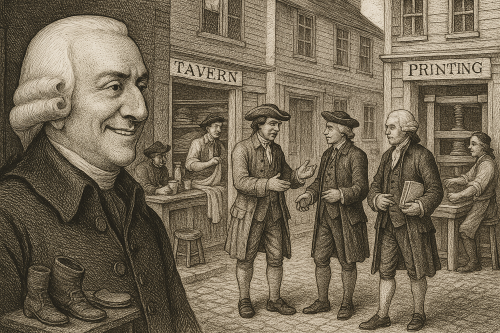
Adam Smith sees America's potential.
Adam Smith sees America's potential.
“[T]hey … are employed in contriving a new form of government for an extensive empire … which, indeed, seems very likely to become … one of the greatest and most formidable that ever was in the world.”
–Adam Smith (1776, Wealth of Nations, 623)
–Adam Smith (1776, Wealth of Nations, 623)
Adam Smith's Wealth of Nations was first published on the cusp of the American Revolution in the turbulent spring of 1776. Smith expresses optimism regarding the ‘new form of government’ that Smith saw the colonists to be ‘employed in contriving.’ In this two-part series, we argue that Smith’s optimism is due to the dovetailing of the principles behind that contrivance with his own notions regarding good governance.
In Part 1, we review Smith’s broad comments on the American colonies in 1776 In Part 2, we will explore five points of Smith’s thought that resonated with the revolutionary colonists in America. You can also see this subject treated at greater length here: “Adam Smith’s Hopes for a Liberal America,” at Economic Affairs.
In Book IV of An Inquiry into the Nature and Causes of the Wealth of Nations (Smith, 1776; hereafter WN), Smith indicts the mercantilist system. He devotes a lengthy chapter to colonies in which he discusses them as yet another mercantilist policy, and a recklessly wasteful one at best. He gives much space to the topic of Great Britain's American colonies. They were a financial drag upon the mother country, and Britain's policy with regard to them was inefficiently protectionist. Still, Britain gained by trade with the American colonies, a land-rich source of materials and enterprise.
There were many reasons for Smith to be apprehensive regarding the future of the colonies. However, when WN appeared on the 9th of March 1776, a few months prior to the July 4th Declaration of Independence and 11 years prior to the commencement of the Constitutional Convention, Smith certainly recognized the great possibilities. He expressed optimism about America's future as an independent power. In this article, we sketch Smith’s reasons for this optimism, drawing on our longer article published in Economic Affairs.
The tumult of the 1760s and 1770s lurks in the background of Smith's chapter on colonies, written as it was with knowledge of the increasing hostility the American colonies felt towards their mother country. Smith says of the leaders in America: “From shopkeepers, tradesmen, and attornies they are become statesmen and legislators, and are employed in contriving a new form of government for an extensive empire, which, they flatter themselves, will become, and which, indeed, seems very likely to become, one of the greatest and most formidable that ever was in the world” (WN, 623, emphasis added).
Smith makes a point of saying that the “present grandeur” (WN, 590) of European colonies is not to be credited to any wisdom of “the policy of Europe” in establishing the colonies or in governing their commerce with the mother country. Having emphasized at length the salutary (or benign) neglect of the colonies' internal governance shown by England (WN, 567–571), Smith says:
In one way, and in one way only, it [the policy of Europe] has contributed a good deal. Magna virûm Mater! [Great Mother of men!]. It bred and formed the men who were capable of achieving such great actions, and of laying the foundation of so great an empire; and there is no other quarter of the world of which the policy is capable of forming, or has ever actually and in fact formed such men. The colonies owe to the policy of Europe the education and great views of their active and enterprising founders; and some of the greatest and most important of them, so far as concerns their internal government, owe to it scarce any thing else.
(WN, 590; emphasis added except in the Latin phrase)
Here, as elsewhere (WN, 586), Smith brings up the character of the colonists and its importance. Smith writes: “There is more equality, therefore, among the English colonists than among the inhabitants of the mother country. Their manners are more republican, and their governments, those of three of the provinces of New England in particular, have hitherto been more republican too” (WN, 585; emphasis added).
Two categories of primary sources help paint the picture of what America's ‘new form of government’ would have looked like to Smith: 1) The early colonial charters and constitutions, and 2) the writings of some of the American Founding Fathers. Comparing these sources with Smith's own thought demonstrates why he would be optimistic about the future of an independent America. In our longer article we sample both kinds of American sources, but in these essays we merely assert their characteristics and examine only Smith’s corresponding thought.
Historical Context
Before 1763, the American colonies had enjoyed what Edmund Burke, in his 1775 ‘Conciliation with the Colonies’ speech before Parliament, termed a period of “salutary neglect” (Burke, 1775, 15). The various colonies, many of which had been established for purposes of religious freedom, had been granted their charters and then, as regarded their internal affairs, largely left to their own devices. As Smith notes, their abundance of land coupled with “liberty to manage their own affairs their own way” gained for them great prosperity (WN, 572). The colonists' experience of self-government and self-administration proved to them that they did not need, nor did they want, the direct or consistent input of Parliament.
Colonial historian J. P. Wallis (1896) writes that from the very outset, Parliament's lack of direct involvement in colonial governance set the course early on for a light-touch relationship between that governing body and the colonies. “Parliament,” he writes, “in its omnipotence might have provided the nascent colonies with ready-made constitutions at the very outset, but it is a remarkable fact, pregnant with grave consequences…that Parliament took little or no part in the early work of colonization” (1896, 60). Parliament let the colonies do as they saw best in setting up their own colonial governance; their charters were granted by the Crown, and that affected the loyalty, or lack thereof, that they would feel towards Parliament in the coming decades.
By the time of George III, however, as David Hume puts it, the geographical separation meant that the American colonists really never knew what having a king was like (Wood, 1991, 16). American historian Gordon Wood (1991) describes how, for a long time, British crown authority had operated in America as merely an overlay on the surface of the decentralized institutions and local authorities
… that made up the central governance of the colonies … [T]he colonists had little understanding of state authority, of a united autonomous political entity that was completely sovereign and reached deep into the localities. And thus they were not prepared to accept that authority when after 1763 it tried to intrude into their lives.
(Wood, 1991, 111)
American colonists had constructed and maintained localized governments with elected leaders. With their largely republican cultural values, they were not accustomed to living under the real power and authority of either the British parliament or the British monarch. They were technically British citizens, but culturally and politically they were republican Massachusettsans, Virginians, and so on — or, simply, Americans. They were established at a far distance from the authority of both the British Crown and Parliament, and the inherited sentiments of many of them included bitterness against the English government because their ancestors had to flee to North America in pursuit of religious freedom. Many had inherited a Puritan attitude of defiance towards both the king and the established church of their motherland (Wood, 1991).
Prior to 1765, Britain had levied only external taxes on the American colonies — taxes on trade, never direct taxes. In the series of tax bills that proceeded from Britain as she attempted colonial reform, the Stamp Act of 1765 was considered the most egregious, not only because it was an internal tax upon American colonists, who were unrepresented in British Parliament, but also because it was essentially a tax on paper, and so it was interpreted as an attack on their press and their self-governance. Despite its repeal a year later, the Stamp Act inflicted significant damage to Parliament's authority in America through the unifying effect it had upon the colonies.
Although still separate political entities, the colonies had all felt the sudden and unwelcome aggression of Great Britain, and they had responded together. The Stamp Act Congress drew representatives from nine of the colonies. A united revolutionary spirit had been stirred, and the colonists were asserting their rights and questioning British rule as they never had before. In an attempt to regain control and tone-deaf to colonial revolt, Britain stationed more troops to settle riots and instructed the colonial governors “to maintain tight control of the assemblies and not to agree to acts that would increase popular representation in the assemblies or the length of time the legislatures sat” (Wood, 2002, 32).
Independence was soon spoken of openly, and political leaders encouraged the colonial governments to resist any of the acts Parliament issued. The following year, when Parliament issued the Coercive Acts, a line was drawn in the sand, and few American revolutionaries could see a peaceful path to reconciliation with the mother country. During 1774–75, when the First and Second Continental Congresses met, it became increasingly clear that not only were the Americans seeking secession from Great Britain, but they also recognized an opportunity to create something new — a form of government modeled after the self-governance they had experienced dating back to the Mayflower Compact of 1620.
When violence broke out in Massachusetts in April of 1775, many colonial leaders were prepared to wage war against Great Britain, having given up on reaching any kind of peaceful resolution. The Declaration of Independence in the summer of 1776 would only formalize the claim of independence that was already being acted upon that spring.
As for Smith’s attitude as of 1776 about what Great Britain should do about the American conflict, it was essentially “Let ‘em go.” Klein (2023) argues that Smith’s proposal for a union was a sly way of promoting letting them go.
In Part 2, we explore five points of Smith’s thought that resonated with the revolutionary colonists in America.
References
Burke, Edmund. 1775. The Speech of https://oll.libertyfund.org/people/edmund-burkeEdmund Burke, Esq; On Moving his Resolutions for Conciliation with the Colonies, March 22, 1775. J. Dodsley.
Klein, D. 2023. Adam Smith’s Sly American Proposal. Reason 55(3), July: 36–40.
Smith, Adam. 1776. (R. Campbell & A. Skinner, Eds.) Liberty Fund (1981)
Wallis, John. 1896. Early colonial constitutions. Transactions of the Royal Historical Society, 10, 59–83.
Wood, Gordon. 2002. The American Revolution: A History. Random House.
Burke, Edmund. 1775. The Speech of https://oll.libertyfund.org/people/edmund-burkeEdmund Burke, Esq; On Moving his Resolutions for Conciliation with the Colonies, March 22, 1775. J. Dodsley.
Klein, D. 2023. Adam Smith’s Sly American Proposal. Reason 55(3), July: 36–40.
Smith, Adam. 1776. (R. Campbell & A. Skinner, Eds.) Liberty Fund (1981)
Wallis, John. 1896. Early colonial constitutions. Transactions of the Royal Historical Society, 10, 59–83.
Wood, Gordon. 2002. The American Revolution: A History. Random House.