Adam Smith Hopes for America, Part 2
September 17, 2025
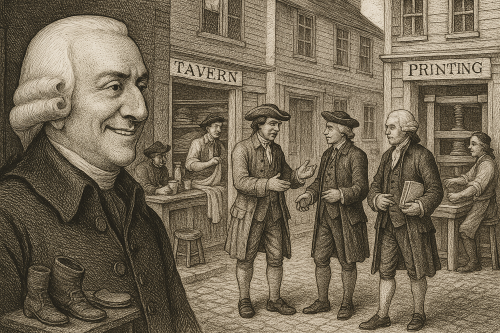
Adam Smith's Wealth of Nations was first published on the cusp of the American Revolution in the turbulent spring of 1776. Smith expresses optimism regarding the ‘new form of government’ that he saw the colonists to be ‘employed in contriving.’ In this two-part series, we argue that Smith’s optimism is due to the dovetailing of the principles behind that contrivance with his own notions regarding good governance.
In Part 1, we reviewed Smith’s broad comments on the American colonies in 1776 and the historical context of the American Revolution.
In Part 2, we explore five points of Smith’s thought that resonated with the revolutionary colonists in America.
You can also see this subject treated at greater length here: “Adam Smith’s Hopes for a Liberal America,” at Economic Affairs.
Five Points of Resonance with Political Thought in America
It is impossible to say with certainty to what extent Smith read the publications coming out of the rebellious colonies during his stay in London between 1773 and 1776. In our long article, we examine the thought of James Otis and John Adams as representative of American thought of the time, and explain its resonance with Smith’s teachings about government and liberty. Here we focus on Smith only and omit further illustration from the American thinkers or the constitutions and charters in America.
Among the points of resonance between Smith and American political thought are (1) subsidiarity (though that term was not used by our eighteenth-century authors), (2) religious freedom, (3) limited and balanced government, (4) free trade and open inland commerce, and (5) the necessity of virtuous governors for the preservation of liberty.
Subsidiarity
Subsidiarity, understood as the idea that decentralized or local community-level decision-making is best, can be found in both The Theory of Moral Sentiments (Smith, 1759; hereafter TMS) and An Inquiry into the Nature and Causes of the Wealth of Nations (Smith, 1776; hereafter WN). In TMS, Smith writes on several occasions of the superior knowledge that those closer to a situation, or closer to the people involved in a situation, have in comparison with those separated by either geography or relation.
Discussing the order in which societies are recommended to men's beneficence, Smith points out that every nation state is separated into “many different orders and societies” and these orders and societies have particular “powers, privileges, and immunities” that are protected by the nation state (TMS, 230–231). The state must indeed protect these unless to do so would be in direct opposition to the good of the whole state. Every citizen of the state, however, is partial to the preservation of his particular order's powers, privileges, and immunities and will be loath to sacrifice them for what the state leaders determine is best for the whole of the state. Smith praises this partiality and credits the preservation of stability and permanency in the whole system of governance to it. Without such partiality, the “spirit of innovation” in politics would be unchecked and the state might take into its control too much of the power dispersed to those orders and societies.
These sentiments support the notion of subsidiarity, recognizing that a realistic understanding of human nature will take into account the fact that men care about the things and people closest to them. Thus self-governance, leaving people to their own affairs, is a presumption suited to man's nature.
Smith also seems to favor governance at the local level in certain passages of WN. When writing on public works and their maintenance, Smith favors the operation of such works, as much as possible, at the local or provincial levels, with funding coming most often based on user fees or “voluntary contribution” (WN, 815). Having an independent source of income prompts independent agency for the operation, whether the service be transportation, court adjudication, or education.
In Book III of WN, when discussing how towns first arrived at liberty faster than the country after the fall of the Roman Empire, Smith to some extent attributes it to the growth of subsidiarity in those towns: When the king allowed freedom to townspeople to join together with each other and form their own local militias, defense mechanisms, magistrates, and by-laws—essentially their own little republics—they grew much stronger and more successful, able to defend themselves against the ruthless barons. The barons were the common enemy of the king and the townspeople and would plunder the cities and towns. Meanwhile, the king was afraid of the barons’ power, so he supported these little republics forming in the towns to defend themselves from the barons. The system that flourished as a result was effective in increasing liberty for the average man through local, republican style self-governance, much like the early colonial American governments (WN, 400–401).
Erik Matson has written on Smith’s “focalism” as found in both TMS and WN, the idea that individuals ought to focus their beneficent efforts and attention on the people and problems nearest them (though not necessarily in the geographic sense), about which they have better knowledge and ability to effectually make decisions (2023). This view is in line with the principle of subsidiarity and its practical recognition of the lesser ability of broader, centralized organizations, political and otherwise, to effectively make decisions about communities, families, and individuals.
Limited and Balanced Government
Smith certainly also favors limited and balanced government both implicitly and explicitly throughout both his works. As Ronald Coase (1976) points out in his analysis of TMS, Smith understands man's nature as capable of benevolence only in particular circumstances. This understanding enables Smith to recognize that those in government are men with the same human nature as any other man, but more insulated from the consequences of their folly in ways that private individuals are not. Such teaching recommends limitations on government power and interference.
In WN, Smith is clearly in favor of limits to governmental power, relegating to the sovereign only three specific duties: protecting the nation from outside threats; protecting men in the nation from one another through the administration of justice; and erecting and maintaining public works and institutions that cannot be maintained privately (WN, 687–688). Other than these duties, the sovereign is to maintain a robust presumption in favor of leaving people free to enjoy their liberty, pursuing their own interests their own way.
Along with his limitations to the power of the sovereign in WN, Smith also outlines many of the same principles of balance of power that the American colonists had in their constitutions and which the Founding Fathers, like Adams, expanded upon.
In a section titled, ‘Of the Expence of Justice,’ Smith writes of the importance of the separation of power to prevent corruption, particularly in the judicial operations of a country. He, like Adams, recommends a fixed salary for judges in order that they not be inclined to make more money from more litigation; he also cites the separation of the judicial from the executive functions of government as crucial for the improvement of a society: “When the judicial is united to the executive power, it is scarce possible that justice should not frequently be sacrificed to, what is vulgarly called, politics” (WN, 722).
His recognition of the dangers of neglecting to ensure separation of the judicial from the executive powers in a government is very much akin to the fears of American thinkers: To secure for every individual the possession of his rights, “it is not only necessary that the judiciary should be separated from the executive power, but that it should be rendered as much as possible independent of that power” (WN, 723).
Smith also writes (WN, 706–707) of the fears that “men of republican principles” have that a standing army will be an enemy of liberty. He allays these fears and rather recommends a standing army as a support for liberty as long as it is under the command of the executive power. The American colonists would recognize this as well, ensuring in their early constitutions that whatever military force existed in a colony, it was under the command of the executive power in that colony.
Government is also limited by the extent to which the rule of law is observed and considered inviolable even by those who govern. The early American religious settlers certainly placed a premium on this idea and designed their institutions accordingly, with written constitutions. The American leaders in the years leading up to independence recognized it as well. Americans’ complaints against Britain were often expressed as hatred of British arbitrariness. The sovereign must rule according to predictable and known law in order for the liberty and security of the citizens to be preserved. Smith recognized this, too, and felt this was a justifiable complaint on the part of the colonies. Smith writes in many places throughout WN of uncertainty as the enemy of liberty and of how arbitrary governance is uncertain governance that enslaves the people it rules. This was perhaps most on display in Britain’s colonial trade policies.
Free Trade and Open Inland Commerce
Nearly all of WN extols the values of free trade, with Smith particularly focusing on this principle in his criticisms of the mercantilist system in Book IV. This is certainly, therefore, a principle he shared with the American thinkers about government and its relationship to society. Smith recognized, as did they, that Great Britain's interventions in American manufacturing and trade amounted to “manifest violations of the most sacred rights of mankind” (WN, 582). The colonies have had “impertinent badges of slavery imposed upon them” (WN, 582) through their mother country's monopoly of the colony trade and its accompanying regulations. The sentiments expressed by American authors leading up to 1776—James Otis and John Adams among them—criticizing the British indirect taxation of America through the control of colonial trade were certainly shared by Smith. Free inland trade and successful uses of American land and labor had already been a significant source of economic growth in the American colonies, particularly in the decades leading up to the Revolution.
Religious Freedom
Turning to religious freedom, Smith writes in Book V of WN of the value in having no established church. His exposition seems to suppose a land like America (WN, 792). Smith never directly calls for disestablishment in Great Britain. While David Hume argues that, at least in certain historical contexts, an established church paid for by the government will inhibit fanaticism and radicalism, Smith expounds on the benefits of keeping government out of the church market.
Smith sees the evils that the combination of ecclesiastical and secular authority has resulted in throughout history. In this “market,” too, Smith maintains that competition is helpful (WN, 793). The best situation for a country, says Smith, is for several competing religious sects to balance one another out. Too few will result in violent opposition between sects, while just one will result in the same issues as an established church. Smith sees the Reformation as a positive influence in human history, breaking the domination of the Roman church and its ties with secular authority in many states. He clearly shared the emphasis on religious liberty maintained by many of the first American settlers and the later writers.
It is not that religion is not important, for Smith or for the early American settlers and Founding Fathers. Smith reminds his readers that the first settlers in America were those fleeing unjust religious persecution in Britain and Europe:
The English puritans, restrained at home, fled for freedom to America, and established there the four governments of New England. The English catholicks, treated with much greater injustice, established that of Maryland; the Quakers that of Pensylvania…Upon all these different occasions it was, not the wisdom and policy, but the disorder and injustice of the European governments, which peopled and cultivated America. (WN, 589).
The value that early Americans placed on religious freedom was born from necessity and from their direct experience of the opposite at the hands of the British and other European powers. As noted by Smith, the religious groups that had the most significant impact on colonial governance were the Puritans or Congregationalists, the Quakers, and to a lesser extent the Anglicans. Each of these religious traditions gave voice to the principles that undergirded the colonial governments first established in America—principles that aligned with many of Smith's own.
Smith writes of a civilizing market discipline in which many competing religious sects confute and check the abuses and absurdities of other sects, obliging all “to learn that candour and moderation which is so seldom to be found” (WN, 793) in monopolistic established churches that become submerged within government. Smith's famous “free-market-in-churches” paragraph begins:
But if politics had never called in the aid of religion, had the conquering [political] party never adopted the tenets of one sect more than those of another, when it had gained the victory, it would probably have dealt equally and impartially with all the different sects, and have allowed every man to chuse his own priest and his own religion as he thought proper. There would in this case, no doubt, have been a great multitude of religious sects. (WN, 792)
Smith's description of a “free market” in religion presupposes that there is not an established church. His optimism about a free market in churches parallels his optimism about America's “new form of government.”
In many ways, the American colonies taken together were already something of a varied market when it came to churches: Different colonies founded with different religious traditions, some with more religious freedom than others, some with established churches. The options were varied for colonial settlers on American shores.
Good Government Depends on Virtue
It was to a new kind of American gentry that many of the leaders of the American revolution belonged; as Gordon Wood states, “[w]e shall never understand the unique character of [these men] until we appreciate the seriousness with which they took these new republican ideas of what it was to be a gentleman.” Born into, and formed by, the religious and political institutional environment cultivated in the colonies during the previous century, they were “self-conscious about the moral and social values necessary for public leadership” in ways that the British nobility were not (Wood, 1991, 197).
These leaders of the American revolution represented the principles Smith discusses in TMS when he describes the two roads through life that a man might take: the road of wisdom and virtue or the road of wealth and greatness (TMS, 62). The road of wisdom and virtue sometimes bends toward wealth and greatness. But the road of wealth and greatness must depart from the road of wisdom and virtue. Smith wrote of those born into “superior stations of life…in the courts of princes, in the drawing rooms of the great…[where] flattery and falsehood too often prevail over merit and abilities” (TMS, 63). Men of more humble or “middling” origins, Smith notes, are more likely to pursue wealth and greatness in conjunction with the pursuit of virtue. Many of the leaders that emerged in America aspired to both, with an ingrained understanding of that “moral precondition of free government” (Beitzinger, 1972, 64).
Like many of the American Founders, perhaps especially Adams, Smith recognized that liberty was not the sole good in politics. He understood that individual liberty was a development of the modern period and, like Hume (1994, 40), that authority is essential to liberty's very existence. Smith well understood that virtue, too, is essential to ordered liberty. In TMS, Smith writes:
What institution of government could tend so much to promote the happiness of mankind as the general prevalence of wisdom and virtue? All government is but an imperfect remedy for the deficiency of these… On the contrary, what civil policy can be so ruinous and destructive as the vices of men? The fatal effects of bad government arise from nothing but that it does not sufficiently guard against the mischiefs which human wickedness gives occasion to. (TMS, 187)
Good character and conduct, then, seem much more important than good government. Bad government is downstream of bad character and conduct on the part of the men who govern.
This is not to say that Smith was in favor of governmental inculcation of virtue. As stated, he wrote against the combination of ecclesiastical and governmental authority. Rather, Smith understood the mutually dependent relationship between good men and good institutions. The role of government is still to merely prevent the harmful actions of others through administration of justice in the polity and in defense from external invasions. The balancing of power and limitations on government can also be seen as part of “guard[ing] against the mischiefs which human wickedness gives occasion to” (TMS, 187). Smith recognized that the wiser and more prudent and virtuous men are, though, the better they will abide by the confines of such a limited government that respects the liberty of the people it governs.
Conclusion
There is significant concurrence between the principles by which the American colonists had designed their governing institutions for the past century, and which they were writing about in the years leading up to spring of 1776, and Smith's own thought as expressed in both TMS and WN. It is more than likely that, seeing this, Smith recognized that their budding independent country was a case study of sorts for many of the principles of his own political outlook. Thus, his optimism regarding their future is less surprising, even given the admittedly valid reasons he would have had for apprehension.
Smith was hardly a starry-eyed idealist, nor even an optimist when it comes to national governance generally. Indeed, a caustic humor toward modern men and modern times appears often in Smith's works. Upon consideration of America, Smith describes the men that are taking the lead both politically and socially in the American colonies as concerned with maintaining their newly achieved positions of importance. Yet he still does not accuse them of being the overly conceited “men of system” with grand plans for new governments that he criticizes in TMS. Perhaps Smith’s favorable assessment results from his recognition that the new government being formed is such that these men will not be able to do the kind of damage that men of system can otherwise do if given free rein in a political economy.
The Americans were jealous of their liberty. They had demonstrated a resistance to slowly encroaching power throughout the tumult of the decades leading up to the time WN was published. As early as 1776, before a united American government was even fully formed, Smith could see America's bright future not just of survival. but of genuine civilizational success. It is clear that he knew what they could be, and likely would be, without the assistance of Great Britain, and their predicted thriving would provide evidence that his own ideas of liberal governance were those best suited for the success of a nation.
References
Beitzinger, Alfons J. 1972. A History of American Political Thought. Dodd, Mead & Company.
Coase, Ronald H. 1976. Adam Smith's view of man. The Journal of Law & Economics, 19(3), 529–546.
Hume, David. 1994. Essays, Moral, Political, and Literary (E. Miller, Ed.). Liberty Fund.
Matson, Erik W. 2023. The Edifying Discourse of Adam Smith: Focalism, Commerce, and Serving the Common Good. Journal of the History of Economic Thought 45(2), June: 298–320.
Smith, Adam. 1759. The Theory of Moral Sentiments (A. Macfie & D. Raphael, Eds.). Oxford University Press (1976).
Smith, Adam. 1763. Lectures on Jurisprudence (R. Meek, D. Raphael, & P. Stein, Eds.). Oxford University Press (1978).
Smith, Adam. 1776. An Inquiry Into the Nature and Causes of the Wealth of Nations (R. Campbell & A. Skinner, Eds.). Liberty Fund (1981).
Wood, Gordon. 1991. The Radicalism of the American Revolution. A. A. Knopf.
Coase, Ronald H. 1976. Adam Smith's view of man. The Journal of Law & Economics, 19(3), 529–546.
Hume, David. 1994. Essays, Moral, Political, and Literary (E. Miller, Ed.). Liberty Fund.
Matson, Erik W. 2023. The Edifying Discourse of Adam Smith: Focalism, Commerce, and Serving the Common Good. Journal of the History of Economic Thought 45(2), June: 298–320.
Smith, Adam. 1759. The Theory of Moral Sentiments (A. Macfie & D. Raphael, Eds.). Oxford University Press (1976).
Smith, Adam. 1763. Lectures on Jurisprudence (R. Meek, D. Raphael, & P. Stein, Eds.). Oxford University Press (1978).
Smith, Adam. 1776. An Inquiry Into the Nature and Causes of the Wealth of Nations (R. Campbell & A. Skinner, Eds.). Liberty Fund (1981).
Wood, Gordon. 1991. The Radicalism of the American Revolution. A. A. Knopf.
Want more like this?
We have a teaching guide for Reading Smith through the American Founding, by Jeremy Gypton.
Check out our conference reading list on Adam Smith and the Political Economy of the Early American Republic
As an Amazon Associate, AdamSmithWorks earns from qualifying purchases.