Adam Smith is Winning the Battle of Ideas
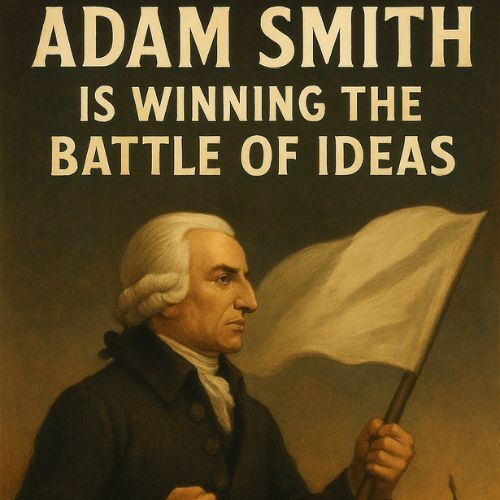
Adam Smith ushered in an intellectual and rhetorical revolution by explaining what he called “the obvious and simple system of natural liberty.”
Little else is requisite to carry a state to the highest degree of opulence from the lowest barbarism, but peace, easy taxes, and a tolerable administration of justice; all the rest being brought about by the natural course of things.
(Adam Smith, An Inquiry into the Nature and Causes of the Wealth of Nations, ed. Edwin Cannan, vol. 1 (London: Methuen, 1776), XXXV–XXXVI.)
Smith describes “the liberal plan of equality, liberty, and justice” (Wealth of Nations, Bk 4, Ch 9). The world could be better on all of these margins, but for about the last two and a half centuries, it has at least been good enough to transform the world from one where everyone’s life is solitary, poor, nasty, brutish, and short to one where our lives are connected, rich, clean, peaceful, and long.
Smith shows us how we got here, and where to go next. As Deirdre McCloskey and I explain in several places, there are practically unlimited possibilities for us and our descendants—as long as we keep our ethical wits about us.
Let’s consider a few of Smith’s insights that might be easy to overlook. First, one of my favorite passages in Smith is one of his most famous:
It is not from the benevolence of the butcher, the brewer, or the baker, that we expect our dinner, but from their regard to their own interest. We address ourselves, not to their humanity but to their self-love, and never talk to them of our own necessities but of their advantages.
(Wealth of Nations, Bk 1, Ch 2)
We don’t get what we want by stamping our feet and demanding it. Only children think they can simply demand food, clothing, and shelter. Smith recognizes a simple dignity: the right to say no. One of the things that gives the butcher, the baker, and the brewer the right to say “no” is the fact that they have their own problems and issues. They have their own families to feed, clothe, and shelter. We don’t expect them to ignore their families’ needs to take care of ours. But let’s consider some of the points in Smith’s triads. The first triad is peace, easy taxes, and a tolerable administration of justice. The second is equality, liberty, and justice.
Peace
The probability that you die at the hands of another person has never been lower. For our ancient ancestors, there was a distressingly high probability that they would meet their untimely demise at the hands of someone from a nearby tribe. I’ve reluctantly accepted the fact that we are probably never going to have a world without war on this side of eternity, but violence is progressively falling as a share of the human experience.
How do we get more peace? On the international level, we don’t need to be isolationists. We would do well to re-adopt the Monroe Doctrine of free trade with everyone and entangling alliances with no one. However, I will freely admit that aggressive communist expansionism in the twentieth century complicates this somewhat.
At the domestic and local level, we can get a lot more peace by simply reducing the number of things for which we call the cops. Drugs? Legalize them. Prostitution? Legalize it. Capitalist acts between consenting adults? Legalize them. In addition to the drug cartels along the Mexican border, there are also avocado cartels. Why? Because we regulate avocado imports with licensing restrictions. When we create economic privileges, it should not surprise us that people work to acquire them. There’s a reason you don’t have back-alley deals for aspirin. We should make the same true for heroin and cocaine.
Easy Taxes
Once again, this could be a lot better, and it is easy to focus on the problems we face in wealthy countries with complex tax codes. The fall of communism and liberalization of India and China, however, effectively emancipated many millions of people from de facto slavery to the state. I worry about our fiscal future, at least a little bit; we focus too much on taxes, I think, and too little on the real burden of government, which is the spending. As Smith and others working in the “mainline” tradition in economics (like James M. Buchanan) explained, there are built-in biases toward debt and debasement because future generations don’t vote. The mainline argument explains why I think it is especially important to rely on markets rather than politics: prices capitalize our expectations about future costs and benefits, which means that they capitalize everyone’s expectations about how future generations will vote with their money. There is no similar mechanism built into political choices.
How do we get easier taxes? As an anarchist, I think the right tax rate is zero on everything. But if we must have taxes, then they should be lower and should not punish people for producing. We should eliminate taxes on labor and capital that discourage production and investment. We should eliminate taxes on inheritances because they discourage people from creating a lasting legacy for their children. If we are going to tax anything, we should tax consumption (extinguishing value, to paraphrase W.H. Hutt) or land, which capitalizes the value of good institutions.
A Tolerable Administration of Justice.
The word “tolerable” is doing a lot of work here. As with peace, I’ve reluctantly accepted the dismal conclusion that perfect justice is simply not going to happen on this side of eternity. It has improved significantly, though, as the rule of law has replaced arbitrary legal institutions that treat people differently based on their family, tribe, or skin color. Could it be much better? Yes, but it is far more “tolerable” than it used to be.
Again, there is considerable room for improvement in this area. We can relieve some of the burden of an overloaded justice system by legalizing acts (of any kind) between consenting adults. Eliminating a significant amount of regulation would significantly simplify this process. There is also considerable room for creativity in dispute resolution. Private arbitration, for instance, is growing and is expected to continue growing. The more we can reclaim the rule of law, the better off we will be.
Smith’s first triad explains why the world got rich. It can further help us understand how to make the world richer. While we don’t yet live in a free-market libertarian paradise, we’re a lot closer than we have ever been–and we know how to make things even better.
In his second triad, Smith explains the importance of the “liberal plan of equality, liberty, and justice.” These definitions might be a little more fraught, as people may disagree more about what they actually mean. Smith’s “liberal plan” is, as Deirdre McCloskey explains, an equality of permission suitable to a society of masterless adults. Erik Matson explains how it is a pattern of “synergistic moral authorizations.”
Equality
“Equality” is often honored in the breach, and societies have a poor track record of actually achieving or creating equality. As I see it, the classical liberal commitment to equality honors the image of God in everyone: no one is better than anyone else. As has been written, no one is born into this world with a saddle on his back, nor is anyone else born booted and spurred to ride him. The image of God imposes significant limitations on what we can do to one another. In a world that adopts the liberal plan of equality, you cannot simply stamp your feet and expect the butcher, the baker, and the brewer to feed you. They are not your slaves, and they are only your servants insofar as you make them an offer they most definitely could refuse but choose not to. Smith’s equality, as Deirdre McCloskey explains, is not an equality of outcome or even of opportunity, both being impossible in a complex world. It is rather an equality of permission–an equality based on liberty.
Liberty
Liberty is a relatively new political innovation, and it is the appropriate default for a world filled with people who bear God’s image. They may use it badly, but they are not animals to be tamed. They are dignified units of consciousness: souls with minds, emotions, and wills that they can deploy poorly or wisely. Liberty and equality pair well; if people are equal, then no one has the right to tell another person what to do unless there is a voluntary arrangement by which the second party agrees to subordinate himself to the first.
Liberty is a relatively new political innovation, and it is the appropriate default for a world filled with people who bear God’s image. They may use it badly, but they are not animals to be tamed. They are dignified units of consciousness: souls with minds, emotions, and wills that they can deploy poorly or wisely. Liberty and equality pair well; if people are equal, then no one has the right to tell another person what to do unless there is a voluntary arrangement by which the second party agrees to subordinate himself to the first.
Justice
Justice is giving people their due–what is theirs by right. Christians are fond of quoting Micah 6:9, which reads, “what has the Lord required of you but to do justice, love mercy, and walk humbly with your God?” One of the most basic ways to “do justice” is to honor your commitments. If you tell someone you will be there at 6 PM, be there at 6 PM. If you lie, cheat, or steal, do what you need to do to make things right. If you are supposed to uphold the law, do so. To do justice is to see that people’s rights are respected—and it begins with the individual seeing that he respects others’ rights and reasonable, established expectations.
The proof of the pudding is in the eating, and we have the proof during what Andrei Shleifer has called “The Age of Milton Friedman.” In the last five decades or so of what has been disparagingly called “neoliberalism,” growth has slowed in countries like the United States that have embraced regulation (think the Environmental Protection Agency) but growth has exploded in countries that have liberalized. Here again, I borrow from the Smithian economist W.H. Hutt. Hutt was a liberal, but not a strict libertarian. He argued, in his constitutional political economy, that the transition from an illiberal to a liberal regime required respecting people’s established expectations. It would be easy, Hutt thought, because liberalization would produce such a torrent of new goods and services that people could arrange to bribe special interests to get them to go along with it.
The world’s population has roughly doubled since the late 1970s, but the number of people living in extreme poverty has plummeted. About 500 million people are living in extreme poverty, which is 500 million too many for my tastes. However, 500 million out of a population of eight billion is much better than 2 billion out of a population of 4 billion. The left has denounced Milton Friedman as the “proud father of global misery.” If the acceleration in standards of living in the last five decades and the emergence of a global middle class is “global misery,” then I’ll take it.
I’m optimistic and hopeful. We’ve seen what has happened as we've adopted the “Bourgeois Deal” – Leave Me Alone and I’ll Make You Rich – and it shows us what we can expect as people keep the deal and expand it further.
Based on remarks at FreedomFest in Memphis, Tennessee, July 13, 2023.
Find more from Art Carden here.
Want to read more?
Liberty Matters: Donald J. Boudreaux, “Deirdre McCloskey and Economists’ Ideas about Ideas” (July 2014)
AdamSmithWorks Essay: Peter Boettke's Why Read Adam Smith Today? Enduring Insight
Speaking of Smith: Michael Munger's Justice and Exchange in Commercial Society
Econlib: Samuel Fleischacker's Economics and the Ordinary Person: Re-reading Adam Smith
Great Antidote podcast: Henry C. Clark on Growth