Adam Smith's Warnings about Exceptions to Free Trade
Adam Smith was a great advocate of free trade, but he did not provide unqualified support for it.
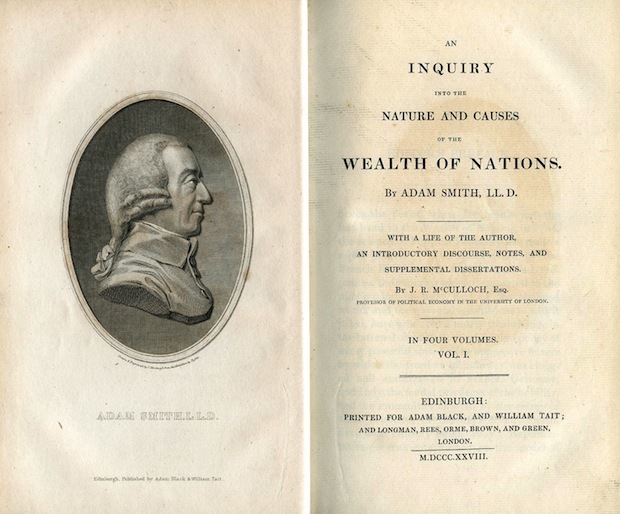
In An Inquiry into the Nature and Causes of the Wealth of Nations (WN), Smith listed two exceptions to free trade and two reasons not to immediately and unilaterally remove all trade barriers.
Unfortunately, Smith’s exceptions might draw more attention than his support for free trade. We should be cautious, not eager, to apply his exceptions. Smith himself was cautious and warned against abusing them.
His two exceptions were for defense and for goods whose domestic production was taxed. His two reasons for not immediately and unilaterally removing all trade barriers were their usefulness in bilateral trade negotiations and the need for a gradual tariff reduction to limit labor market shocks.
However, Smith recognized that his exceptions needed to be used judiciously because otherwise they could be used to justify mercantilism.
Smith’s commentary on the defense exception is the most indirect of his exceptions. He moved from stating that there should be an exception to free trade for defensive purposes to commentary on the propriety of the Navigation Acts, a series of British trade regulations, which had been justified on partially defensive grounds.
Although his commentary on the Navigation Acts can initially seem positive, there is reason to believe that he was quite critical of them, as they sparked conflict with the Dutch, were generally ineffective at improving British defensive capabilities, and made Britain dependent on trade with the American colonies (WN, pp. 371, 463-465, 596, 597-598, 606). Regardless, Smith’s initial general comments on the defense exception to free trade was cut short by his transition to commentary on the Navigation Acts.
Later in Wealth of Nations, he connects his commentary on the herring buss bounty to the defense exception to free trade. The herring buss bounties were subsidies paid to herring fishers based on the tonnage of their buss (seagoing fishing vessel). He wrote that the herring bus bounties do “not contribute to the opulence of the nation, it may perhaps be thought, that they contribute to its defense, by augmenting the number of its sailors and shipping (WN, p. 518).” However, he saw four problems with the bounties: they were too large (WN, p. 519); they were determined by ship size instead of quantity of herring caught (WN, p. 520); Scotland was better suited for boat fishery than buss fishery (WN, pp. 520-521); and buss fishery disrupted the domestic production of herring, which was an important source of food for the Scots (WN, pp. 521-522).
Simply claiming that a policy could potentially promote defense was not enough to justify the policy in Smith’s book.
His other exception to free trade was allowance for a tax on imports equal to domestic production taxes on similar goods. The point was to limit distortions in the tax code. Rather than offering protection, the tariff would simply level the playing field. However, Smith warned of the temptation to extend the tariffs beyond the goods taxed at home. That would produce the very distortion he warned against.
In Smith’s time, the most common argument for imposing general taxes on imports instead of targeted, balancing taxes was that home taxes on necessities increased the price of labor domestically, which in turn raised the price of all goods. The belief that taxing necessities increased the price of labor came from the idea that workers' wages depended on the cost of subsistence, so taxes that increased the cost of living for workers would force employers to raise wages. Smith thought that “balancing” the negative effects of taxes on necessities was ridiculous. He pointed out, first, that calculating the effect on labor prices would be impossible, as would calculating how labor prices affected the prices of each commodity. Second, if taxing laborers makes all goods more expensive, to “lay a new tax upon them, … to make them likewise pay too dear for the greater part of other commodities, is certainly a most absurd way of making amends (WN, p. 466).”
As noted, Smith saw potential use for tariffs in advancing trade negotiations and for a gradual reduction to ease market adjustment. But he warned of the limitations of these exceptions.
He said there “may be good policy in retaliations of this kind, when there is a probability that they will procure the repeal of the high duties or prohibitions complained of (WN, p. 468).” But he added that Dutch retaliatory tariffs on the French sparked a war in 1672. He also emphasized that tariffs impose “a real tax upon the whole country” and that when “there is no probability that any such repeal can be procured, it seems a bad method of compensating the injury done to certain classes of our people, to do another injury ourselves, not only to those classes, but to almost all the other classes of them (WN, p. 468).”
So, Smith believed that retaliatory tariffs were a tool that could be used by statesmen, but they were tools that required care. Without such care, the statesmen would bring home economic ruin and, potentially, war to the doorstep of the nation.
Finally, Smith noted that if trade was unfree, the wisest decision was not always to liberalize trade immediately. Rather, it could be sensible to gradually repeal the barriers, which would give markets a chance to adjust.
Moreover, he warned against the temptation to overstate the need for gradual liberalization. Manufacturers would tend to overstate their reliance on protection, and labor markets were quite flexible and could rapidly adapt to shocks. For example, after a war, soldiers and sailors rush back into the labor market, which handles those situations well. Smith expected that the same would be true with labor-market churn after sudden liberalization.
Smith is a well-known defender of free trade, which is why his exceptions might garner significant attention. That attention should be tempered by the recognition that Smith did not see them as blank checks for policymakers. It would serve us well to heed his warnings.