A Plea to Adam Smith Scholars
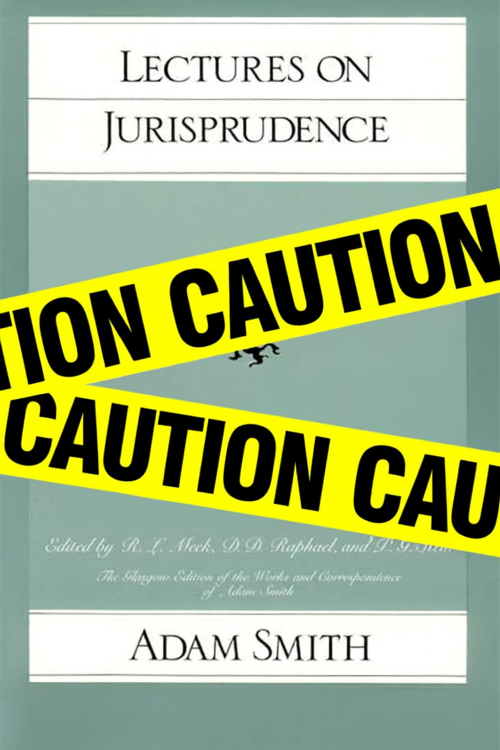
Scholars should be cautious when citing Adam Smith’s Lectures on Jurisprudence. It is intellectually dubious—and perhaps even morally wrong—to cite Smith’s early law lectures without qualification.
My plea to Adam Smith scholars is this: stop citing Adam Smith’s Lectures on Jurisprudence (Smith 1978) without proper qualification, let alone a disclaimer. Although this work purports to be a primary source—a transcription of Smith’s law lectures at the University of Glasgow—these student lecture notes pose two practical problems. One is that we have no idea how faithful or accurate this transcription of Smith’s law lectures is. The other problem is that Smith himself may have repudiated the ideas contained in those early law lectures. After all, he was writing a book on jurisprudence, and he specifically chose not to publish that book.
As a result, if scholars are going to cite Adam Smith’s Lectures on Jurisprudence, two qualifications or disclaimers are in order. The first and most obvious one is that those lectures consist of student notes, not Adam Smith’s own lecture notes.[1] They were transcribed by one or more of Smith’s students but not discovered until over 100 years later, so we have no way of knowing or confirming just how faithful or accurate those student notes are.[2] The second qualification is even more significant, for like Smith’s lectures on natural religion, his law lectures may not represent the Scottish philosopher’s own ideas at all. That is, even if those lecture notes were totally accurate—i.e. even if they were to contain a word-for-word transcription of Smith’s law lectures—it is likely that the Scottish philosopher may have refined, or perhaps even repudiated, the ideas in those lecture notes.
Let me explain: Adam Smith was working on a separate book on a “theory of jurisprudence” for over 30 years—a major intellectual project that no doubt must have sprung from his law lectures while he was still a professor at the University of Glasgow. But Smith expressly decided against its publication. Even as late as the sixth and last edition of The Theory of Moral Sentiments (Smith 1982), which was published in 1790, Smith himself refers to this third great work (emphasis added in boldface):
In the last paragraph of the first Edition of the present work [published in 1759], I said, that I should in another discourse endeavour to give an account of the general principles of law and government, and of the different revolutions which they had undergone in the different ages and periods of society; not only in what concerns justice, but in what concerns police, revenue, and arms, and whatever else is the object of law. In the Enquiry concerning the Nature and Causes of the Wealth of Nations, I have partly executed this promise; at least so far as concerns police, revenue, and arms. What remains, the theory of jurisprudence, which I have long projected, I have hitherto been hindered from executing, by the same occupations which had till now prevented me from revising the present work. Though my very advanced age leaves me, I acknowledge, very little expectation of ever being able to execute this great work to my own satisfaction; yet, as I have not altogether abandoned the design, and as I wish still to continue under the obligation of doing what I can, I have allowed the paragraph to remain as it was published more than thirty years ago, when I entertained no doubt of being able to execute every thing which it announced. (TMS, VII.iv.37)
Although we don’t know for sure, it is natural to assume that Smith’s Lectures on Jurisprudence was the original source material of this third great book he was working on for so many years. Alas, the manuscript of this work not only remained incomplete when Smith died in July of 1790. Smith also specifically instructed his literary executors—the chemist Joseph Black and the geologist James Hutton—to destroy it. By all accounts, they carried out Smith’s dying wish just days before his demise.[3]
Smith’s desire to keep his unfinished book on jurisprudence from seeing the light of day thus raises an intriguing possibility: that his decision to destroy his manuscript was, in fact, Smith’s last word about his theory of jurisprudence.[4] In other words, Smith had his unfinished book thrown into his literary bonfire, not because his work was incomplete or unfinished, but because he had nothing more to say on this subject, i.e. beyond what he had already written in Book V of An Inquiry into the Nature and Causes of the Wealth of Nations (The Wealth of Nations). If this conjecture is correct, then why are we still citing the Lectures on Jurisprudence?
That said, I will nevertheless identify two narrow circumstances, by way of exception, in which citing Lectures on Jurisprudence is perfectly permissible. One is to show whether Adam Smith’s ideas about “law and government” in Book V of The Wealth of Nations changed over time.[5] The other is to present a conjecture or guess as to the actual content or substance of Adam Smith’s theory of jurisprudence.[6]
In closing, scholars should be more cautious and circumspect when citing Adam Smith’s Lectures on Jurisprudence. It’s one thing to cite one of the Scottish philosopher’s great published works, such as The Theory of Moral Sentiments or The Wealth of Nations, but it is intellectually dubious—and perhaps even morally wrong—to cite Smith’s early law lectures without mentioning the two qualifications discussed above.
Works Cited
Guerra-Pujol, F. E., and Alain Alcouffe. Adam Smith in the city of lights. Adam Smith Review, Vol. 15 (in press). Preprint: https://papers.ssrn.com/sol3/papers.cfm?abstract_id=4967381
Guerra-Pujol, F. E., and Alain Alcouffe. Adam Smith in the salons of Paris. Social Science Research Network (forthcoming). Preprint: https://papers.ssrn.com/sol3/papers.cfm?abstract_id=5264490
Hart, David. Adam Smith, Lectures on Jurisprudence (1762-1766), David Hart’s Webpage (Nov. 16, 2023), https://perma.cc/G63F-9Y4C. Original URL: http://davidmhart.com/liberty/EnglishClassicalLiberals/Smith/Jurisprudence/1766-edition/index.html
Malloy, Robin Paul. Law and the invisible hand: a theory of Adam Smith's jurisprudence. Cambridge University Press, 2021.
Meek, Ronald L., D. D. Raphael, and Peter Stein (editors). Lectures on Jurisprudence, Glasgow Edition of the Works and Correspondence of Adam Smith, Vol. 5. Oxford University Press, 1976.
Metzger, Ernest. Adam Smith’s Historical Jurisprudence and the “Method of the Civilians”. Loyola Law Review, Vol. 56 (2021), pp. 1-31.
Neily, Clark. A modern lawyer and Smith’s lectures on jurisprudence, part 1. AdamSmithWorks (Sep. 30, 2019), https://perma.cc/FQ8V-PF2N. Original URL: https://www.adamsmithworks.org/speakings/clark-neily-modern-lawyer-and-smith-s-lectures-on-jurisprudence-part-1
Pesciarelli, Enzo. On Adam Smith’s lectures on jurisprudence. Scottish Journal of Political Economy, Vol. 33, No. 1 (1986), pp. 74-85.
Piqué, Pilar. The Theory of Moral Sentiments and The Wealth of Nations. Ethics, jurisprudence, and political economy throughout the intellectual history of Adam Smith. Journal of Philosophical Economics, Vol. 12, No. 2 (2019), pp. 75-96.
Rae, John. Life of Adam Smith, Macmillan, 1895.
Smith, Adam. Lectures on Jurisprudence. Edited by Ronald L. Meek, D. D. Raphael, and Peter G. Stein. Clarendon Press, 1978.
Smith, Adam. The Theory of Moral Sentiments. Edited by D. D. Raphael and A. L. Macfie. Liberty Fund, 1982.
[2] As an aside, some scholarly sources incorrectly date the second set of Smith’s law lectures to 1766. See, e.g., Hart 2023; Meek, et al., 1976; Neily 2019. But this is wrong, for Adam Smith was overseas that year. See Guerra-Pujol & Alcouffe, in press. In fact, Smith had stopped lecturing at Glasgow by the end of 1763 and had formally resigned his professorship for good in February of 1764. Ibid. In short, instead of delivering law lectures at the University of Glasgow, Smith was visiting the salons of Paris in 1766. See Guerra-Pujol & Alcouffe, forthcoming.
[3] Cf. Rae 1895, p. 434: “When Smith felt his end to be approaching he evinced great anxiety to have all his papers destroyed except the few which he judged to be in a sufficiently finished state to deserve publication, and being apparently too feeble to undertake the task himself, he repeatedly begged his friends Black and Hutton to destroy them for him…. Black and Hutton always put off complying with Smith’s entreaties in the hope of his recovering his health or perhaps changing his mind; but at length, a week before his death, he expressly sent for them, and asked them then and there to burn sixteen volumes of manuscript to which he directed them. This they did without knowing or asking what they contained.”
[4] I credit my colleague and friend Ryan Griffiths for presenting this possibility at a conference in June of 2023 at the University of Glasgow.
[5] See, e.g., Piqué 2019.
[6] See, e.g., Malloy 2022; Metzger 2010.