The most judgmental Austen heroine
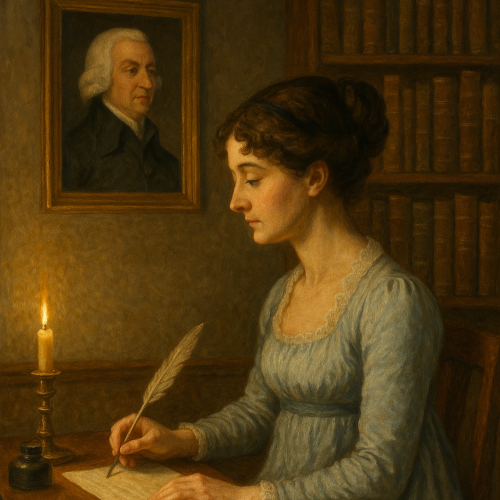
Once again, Jane Austen offers plenty of juicy examples to help us understand the concepts laid out by Adam Smith.
In Part VII, Section II, Chapter 1 of The Theory of Moral Sentiments (TMS), Adam Smith discusses virtue, justice, and propriety, which makes this section a suitable companion to the unfinished novel Sanditon by Jane Austen, because Charlotte Heywood, the heroine, appears to be the most judgmental of Austen’s heroines.(Every reference to the novel Sanditon in this article refers to the original incomplete Austen manuscript.) In stark contrast to Elizabeth Bennet, Charlotte discerns the characters of the people she meets in Sanditon during her first conversations with them.
Charlotte is able to make quick judgments about who to trust. Smith, summarizing Plato, would describe her as having a clear judging faculty: “Under this appellation, it is evident, [Plato] comprehended not only that faculty by which we judge of truth and falsehood, but that by which we judge of the propriety or impropriety of desires and affections.” (Emphasis mine.)
We learn about Charlotte’s upbringing in the description of her parents, “Marrying early and having a very numerous family, their movements had long been limited to one small circle… the maintenance, education and fitting out of fourteen children demanded a very quiet, settled, careful course of life… What prudence had at first enjoined, was now rendered pleasant by habit,” (Sanditon Ch. 2). Charlotte learned prudence from her parents and uses that prudence to evaluate the people she meets when she leaves home to visit Sanditon as a guest of Thomas and Mary Parker.
Sir Edward
In Chapter 7, Sir Edward Denham and his sister Miss Esther Denham visit the Parkers and Sir Edward immediately makes Charlotte the focus of his attention. At first, Charlotte is flattered, but when Lady Denham walks by the house with Miss Clara Brereton, Sir Edward is distracted. When Edward immediately leaves to follow Clara, Charlotte re-examines his behavior and her reaction and was “cured of her halfhour’s fever, and placed her in a more capable state of judging,” (Sanditon, Ch. 7). She completes the process of letting go of self-love to invoke the impartial spectator-- a process that took Elizabeth Bennet half a novel to complete, as I wrote in my previous post.
The next time Sir Edward and Charlotte meet, they talk about novels. Sir Edward rails against “sentimental novels” until Charlotte is annoyed to the point of ending the conversation.
The narrator explains that Edward was attracted to novels with impassioned characters, “The truth was that Sir Edward whom circumstances had confined very much to one spot had read more sentimental novels than agreed with him,” (Sanditon, Ch. 8). Sir Edward particularly identified with the villains in these stories! “Man’s determined pursuit of women in defiance of every feeling and convenience is concerned, had since occupied the greater part of his literary hours, and formed his character,” (ibid.).
According to Plato’s framework (as summarized by Smith), Sir Edward’s passions were not being properly governed by his judging faculty. “We often become the objects of our own resentment and indignation, when the love of pleasure prompts to do what we disapprove of;” (TMS Part VII, Section II, Ch. 1). Sir Edward’s judging faculty is so malformed, that he has the clear intention of seducing Clara, whether or not she consents. “It was Clara whom he meant to seduce… If she could not be won by affection, he must carry her off. He knew his business,” (Sanditon, Ch. 8).
Sir Edward’s intentions are to commit one of the most shameful acts that exist, as Smith explains, “Breach of chastity dishonours irretrievably. No circumstances, no solicitation can excuse it; no sorry, no repentance atone for it. We are so nice in this respect that even a rape dishonours, and the innocence of the mind cannot, in our imagination, wash out the pollution of the body,” (TMS Part VII, Section IV). Charlotte doesn’t know all that, but she does know that his disingenuous, flirtatious attention to herself was bad enough for her to not want to continue a friendship with him.
Lady Denham
Mr. Parker spent a lot of time describing Lady Denham to Charlotte because she has the highest social status in Sanditon. At this point in the story, she has three young relatives trying to win her favor so that they could inherit her wealth. Lady Denham hosts Clara in her home, but she refuses to host Sir Edward and Miss Denham because she doesn’t want to pay her housemaids more to take care of them.
Can Smith’s scenario with the highwayman help us interpret the mean influence of Lady Denham? In Part VII, Section IV, Smith describes a scenario of a gentleman promising to pay some sum of money to a highwayman. If he breaks that promise, then there are a number of variables to consider whether or not the gentleman has behaved justly. If the amount of money is small, then the gentleman should keep his promise. If the amount of money would hinder his obligations to himself or to others, then breaking the promise is not as unjust.
“To fix, however, by any precise rule, what degree of regard ought to be paid to it, or what might be the greatest sum which could be due from it, is evidently impossible. This would vary according to the characters of the persons, according to their circumstances, according to the solemnity of the promise, and even according to the incidents of the rencounter; and if the promiser had been treated with a great deal of that sort of gallantry, which is sometimes to be met with in persons of the most abandoned characters, more would seem due than upon other occasions.”
Regarding Lady Denham and her relatives, the characters of all involved have to be considered and whether or not there is a firm obligation for Lady Denham to provide for them. Smith also notes that people with bad characters can flatter their way to deserving more attention.
“But as was formerly taken notice of, we have no precise rules to determine what external actions are due from a regard to such motives, nor, consequently, when it is that those virtues are inconsistent with the observance of such promises.” (TMS Part VII, Section IV).
If Lady Denham plays the part of the gentleman in that scenario, then Sir Edward, Miss Denham, and Clara are each highwaymen to be evaluated for how much they deserve to receive. There is no clear equation to determine how much money Lady Denham owes her relatives.
Charlotte judges that Lady Denham is wealthy enough that she should show more generosity to her relatives, no matter what character Sir Edward, Miss Denham and Clara possess.
“‘She is thoroughly mean… I can see no good in her… And she makes everybody mean about her. -- This poor Sir Edward and his sister, -- how far nature meant them to be respectable I cannot tell, -- but they are obliged to be mean in their servility to her.-- And I am mean too, in giving her my attention with the appearance of coinciding with her. -- Thus it is, when rich people are sordid,’” (Sanditon, Chapter 7).
Lady Denham’s wealth and position give her so much influence, that her lack of generosity infects everyone around her. She has an obligation to the public interest to model generosity and Charlotte determines that she dishonors herself and the society of Sanditon by her meanness.
Charlotte finds plenty of quirks to judge in the Parker family, as well. It’s a shame we don’t have the rest of the novel to let us know if these judgments would become softened through the course of events. Once again, Jane Austen offers plenty of juicy examples to help us understand the concepts laid out by Adam Smith.
More by this author
Lovers need Smith's Impartial Spectator too.
Smithian Imagination and Austen's Catharine or the Bower
More on the Adam Smith-Jane Austen connection
Cynthia Argentine and Julianna Argentine's Adam Smith Knew Why We’d Love Jane Austen
Sarah Skwire, Sir William Lucas Should Have Read Adam Smith
Shannon Chamberlain, Adam Smith Suggests You Read a Romance Novel (and Have a Laugh at Yourself)